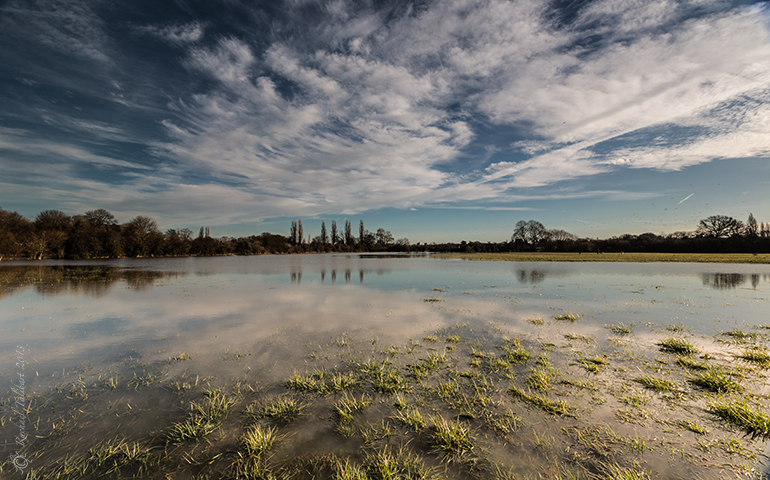
Although the Thames has subsided quite a lot since the worst of the floods earlier this month, it is going to take some time for the waterlogged soil to dry out. This was the scene at the local rugby and cricket club this morning.

The standing water makes for some pretty reflections, but not much good for playing!

Still, there is improvement; I couldn’t have stood in this spot last week.
Tag Archives: photography
On Hampton bridge
Warmer times
Seven Dials
I was out photographing the floods again today but I thought I’d ring the changes here with a shot from last Friday. Traffic light trails around Seven Dials in Covent Garden, London.
PS For those who were curious after my post yesterday, I told her it would be better if she learned to take pictures with the camera she had, showed her the HDR button on her iPhone and invited her to join my camera club!
Hampton, floods and a big stopper
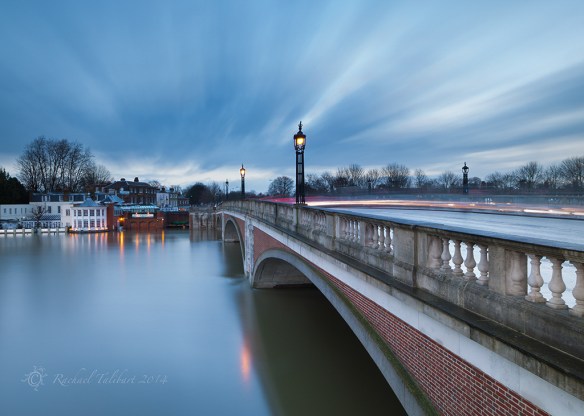
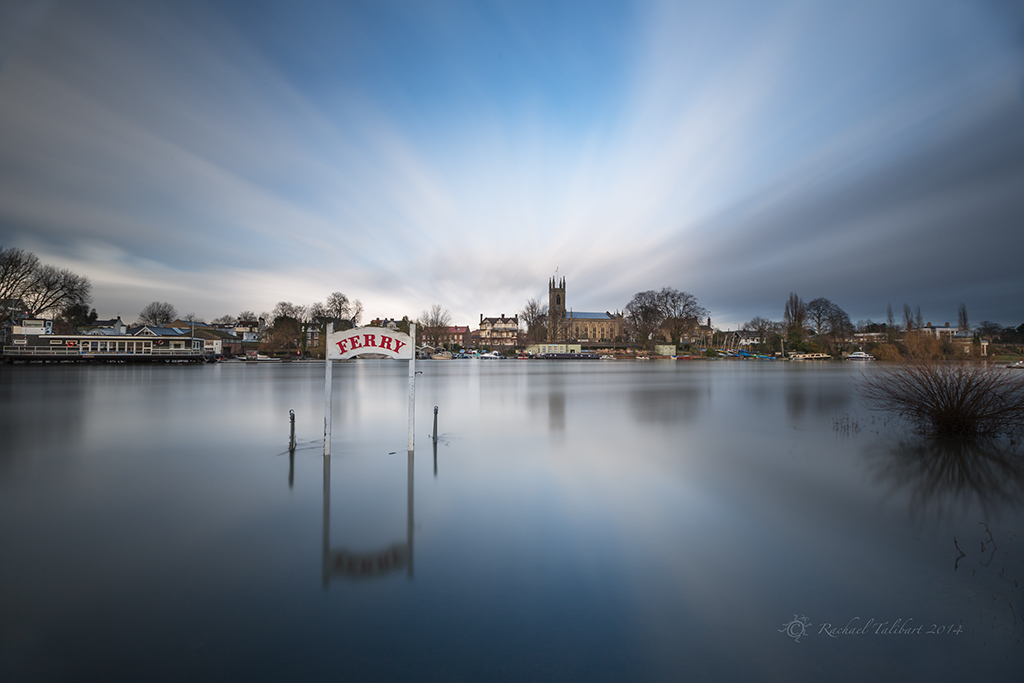
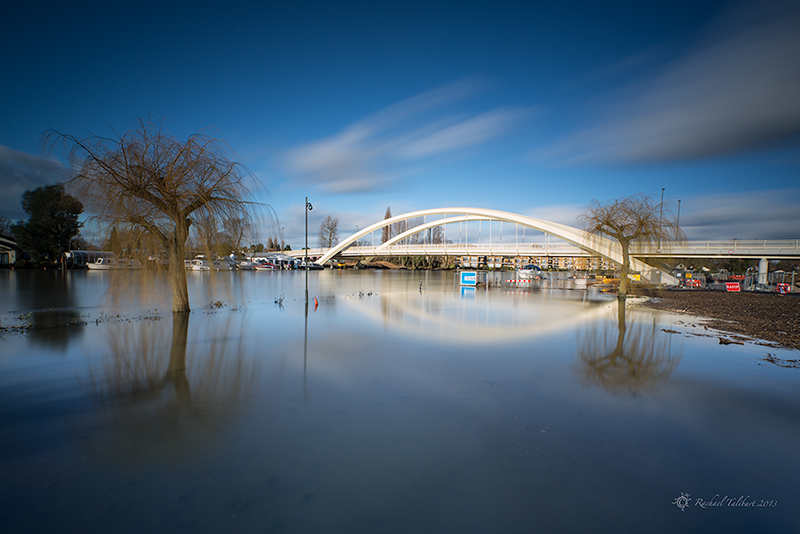
I found an hour this afternoon to take some pictures of the now-thankfully-receding floodwater at Hampton using my 10-stop ND filter. I expect the novelty of the ‘big stopper’ will wear off eventually but, for now, what fun! As for the floods, the Thames is definitely considerably lower today, but we had heavy rain again this evening…
I was amused when a young woman came up behind me and asked if she could take a picture with her iPhone ‘through’ my camera. What would you have said?
More murmurations

Last month, I posted some images of our local starling murmuration. I popped back three times last week and was delighted to find them still there, doing their thing, only in greater numbers. Yesterday was the best yet as the sunset kindly provided a colourful backdrop.

Waterworld

As some of you may have read on the news, here in Surrey we are experiencing some seriously epic flooding as the Thames bursts its banks.
We are safe and dry at home here, safely removed by a small hill from the danger, but I have friends who are anxiously watching as the water level rises ever higher.
I could hardly resist popping out today and yesterday to capture the changed landscape, or should I say waterscape, of my local area.
Dolphins
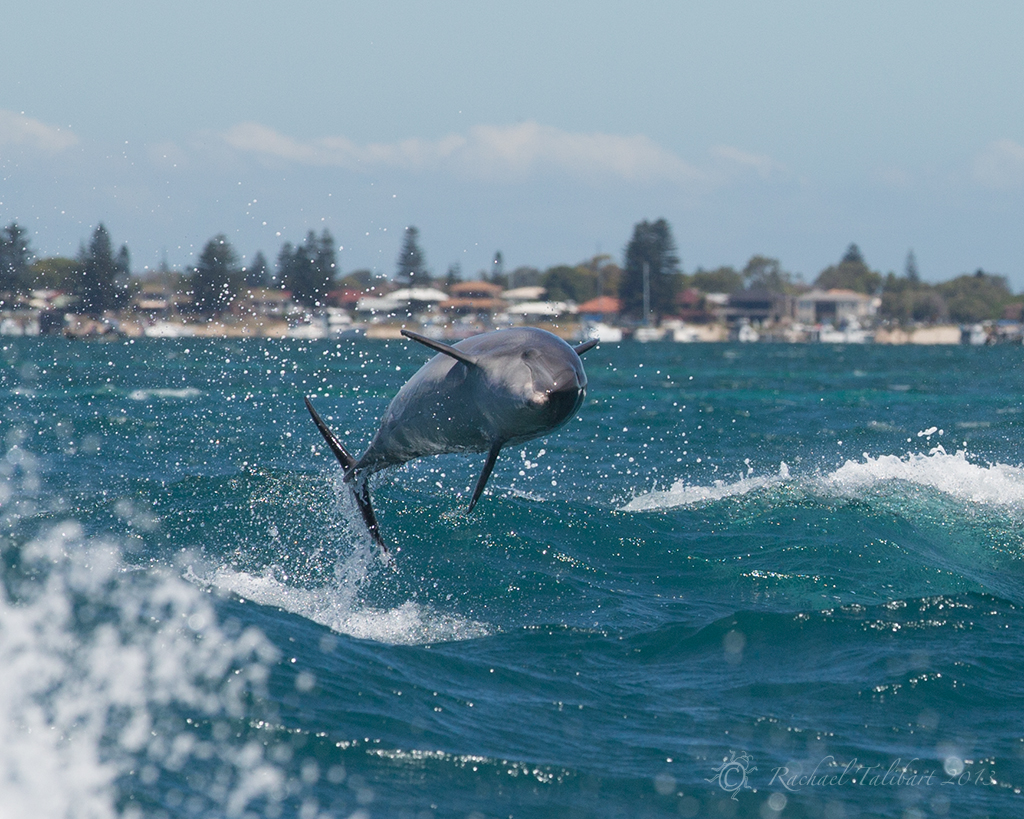
We were lucky, during our trip to Western Australia last month, to meet some dolphins. 
“For instance, on the planet Earth, man had always assumed that he was more intelligent than dolphins because he had achieved so much—the wheel, New York, wars and so on—whilst all the dolphins had ever done was muck about in the water having a good time. But conversely, the dolphins had always believed that they were far more intelligent than man—for precisely the same reasons.”
– Douglas Adams, The Hitchhiker’s Guide to the Galaxy
Shooting stars
One last night sky shot from our trip to Western Australia. On the two nights I managed to get out with my camera at Smiths Beach, Yallingup, meteors showed up in almost every shot. Very exciting! Can you see my husband, up on the dune?
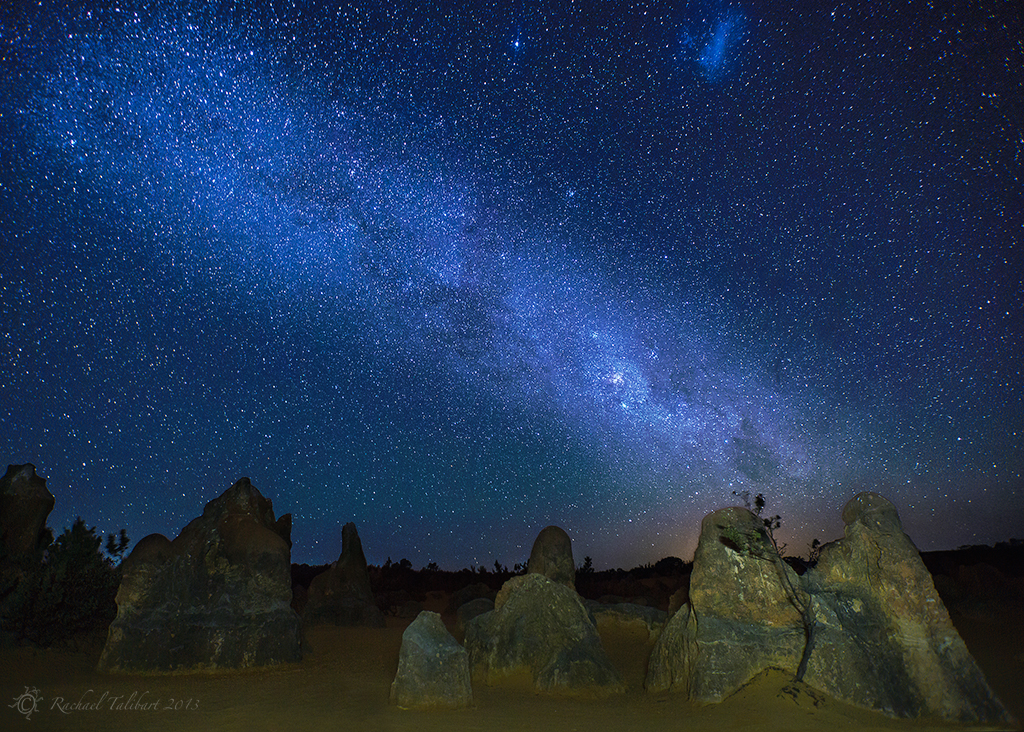
I knew there would be a chance of seeing the milky way during our visit. Having never tried this sort of photography before, I read up on techniques before we went. The following is what I read as adjusted by my experiences in the field. But remember, I am very much a beginner at this sort of photography!
For best viewing of the milky way, you need a location as far away from other light sources as possible. So, away from settlements and roads, and on a night with as little moon as possible. Luckily, our stay in Yallingup coincided with a relatively late moonrise. On the first night, it rose two and a half hours after sunset, and later on the second. That did mean I had to work quickly, as it is best to leave at least a two hour gap after sunset to be sure of a dark sky. In the image above, the greenish light entering from the left is the moon still below the horizon but beginning to make its presence known.
I had read that a 30 second exposure was best as anything longer and the earth’s rotation would make the stars start to streak. Although I stuck to this advice, now that I have seen my images on the big screen at home, I think that 20 seconds would have been better; there are signs of movement in my skies.
In order to get as much light as possible to the sensor, I used f2.8, the widest aperture my 16-35mm lens can achieve. Depth of field is not a major issue at 16mm! Of course, the very dark conditions that make the milky way visible also make high ISOs necessary. I used 1600 or 3200. As I mentioned in my last post, this introduces quite a bit of noise. I am working on refining my editing to mitigate the noise (many thanks to those who have recommended noise reduction plugins – I will try them all!).
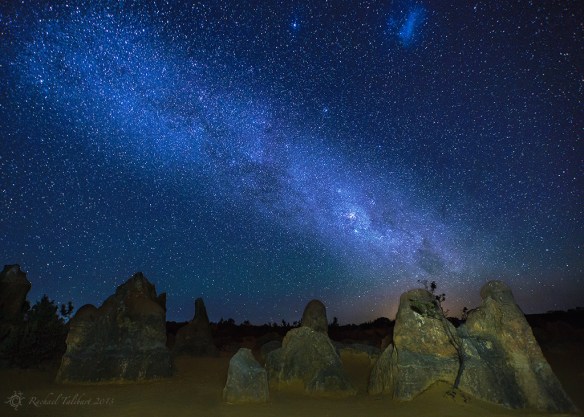
Focusing is tricky in the dark too. I had read that focusing to infinity was best but I found in practice it was better just a notch less than infinity. Perhaps a quirk of my lens. If you want to focus on something closer, like the pinnacles in my first star shot (reproduced below), then a torch shone on the object is invaluable. Incidentally, I used my iPhone’s torch app to illuminate the pinnacles. Otherwise, they would have been silhouettes.
Perhaps the trickiest thing of all is finding your way in the dark with a heavy backpack and tripod. It was fairly easy on the beach but at Pinnacles it was a little bit daunting, walking out into the desert with no lights or signs to guide you if you lost your bearings. My husband was worried about driving the car on the dirt and sand track so we left it in the car park. Probably a mistake with hindsight! Note to self: next time hire a 4X4.
One final note, I understand that the best time to view the milky way is during winter (so May-August in Australia). I am going to make that my excuse for not seeing and capturing something like the winning image in Astronomy Photographer of the Year! Inspirational stuff.

River of stars
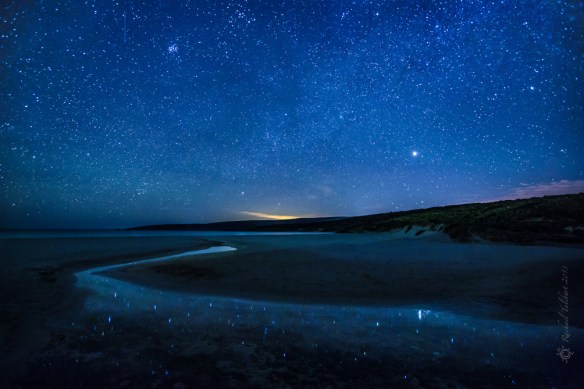
I was lucky, during this trip to Western Australia, to have three opportunities to shoot the night sky. This shot was taken at Smiths Beach bear Yallingup, in the South Western part of the state. Out shooting the sunset a day earlier I noticed a small river running into the sand and hoped it might reflect the stars later. By the next evening, the river had nearly dried up, but there was just enough water left to create some reflections.
One of the problems I have encountered shooting starscapes is that you have to bump up the ISO. This is because any exposure of longer than 30 seconds begins to record the movement of the stars. Of course, higher ISOs mean more noise. It’s not so much of an issue in the sky as it’s already speckled with stars, although even there it can start to look messy. It shows up more in the foreground, especially the sand in this shot. Here I have applied some noise reduction in ACR, more for the foreground and a little in the sky, but at the cost of some of the definition in the stars. It’s a difficult balancing act that will take me a while to master. I suspect I need to investigate some of the noise reduction plugins.
One more astrophotography post tomorrow, with full details of technique.