The Cathedral of the Thames Valley

20120610-113643.jpg

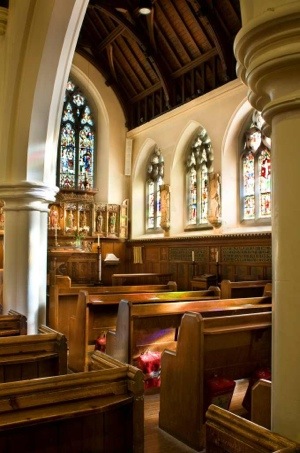
A view of St.James’s, a beautiful Victorian church in Weybridge, Surrey designed by Sir John Loughborough Pearson. This is a series of shots I took in 2009 pro bono to support the renovations work of The Friends of St.James.

20120610-113740.jpg

The Church of Saint Nicholas stood on this site from 1175 until the middle of the nineteenth century. St Nicholas’s was demolished in 1846 and a rebuilding programme was commenced.
The new church was dedicated to Saint James and was consecrated in 1848. Seven years later the Spire was completed, and in 1864 the South Aisle was built. A further eleven years would pass before, in 1875, the ‘Eight Bells’ were dedicated.

20120610-114018.jpg

Finally, in 1889, the Chancel was enlarged and the outer South Aisle was added; it was also at this time that the height of the Chancel was increased by roughly ten feet which gave a better harmony to the overall proportions of the building. The interior of the church is a lovely example of arts and crafts design.

20120610-114116.jpg

Installed in the West face of the south aisle is the Sacramental Window. Made from Victorian stained glass, it is probably intended to depict the sacraments of the church. This important window is made after a design by the celebrated pre-raphaelite, Edward Burne-Jones.

20120610-114250.jpg

St.James’s is the work of John Loughborough Pearson. Pearson, 1817-97, was a Gothic Revival architect renowned for his work on churches and cathedrals. Pearson revived and practised the art of vaulting, and acquired in it skill unmatched in his generation. St.James’s has been described as the ‘Cathedral of the Thames Valley’.

20120610-114523.jpg

20120610-120708.jpg

20120610-120756.jpg

Beachy Head Lighthouse

20120609-223034.jpg

This is Beachy Head Lighthouse, East Sussex. I took this shot on a blustery day in May 2010, as scudding clouds created shadow patterns over the shallow water at the base of the chalk cliffs the lighthouse guards. The lighthouse was built in 1902, warning ships of the cliffs with a light at night and its bright stripes by day. In September, Trinity House announced that it could no longer justify the cost of painting the lighthouse, modern navigational aids making this precaution redundant. Needless to say, many people are reluctant to see the lighthouse fade to grey and a campaign has been running ever since to raise the funds to keep this iconic lighthouse beautiful.

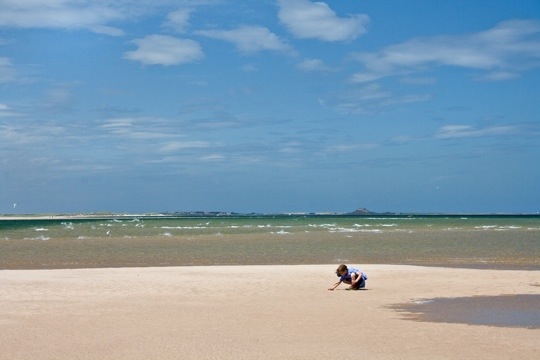
Little figure, big world

20120608-100923.jpg
Camber Sands, East Sussex, England

A quick post today to thank two fellow bloggers for nominating me for awards. Thank you, Ann Jasmine at Not Yet Grounded and Rob at In My View for the nominations. I have decided not to participate in blog awards, being averse to anything resembling chain letters. It is reward enough for me that anyone reads my blog. I will, however, take the opportunity to mention some of the lovely blogs I have discovered during my first two months here on WordPress.

Visit The Goat that Wrote for amusing, well-written and well-illustrated tales with a globe trotting and hiking theme.

Tricia A. Mitchell has lived and/or travelled in some of the most fascinating places and she shares her experiences with an unflagging appreciation for all she encounters.

Modern Memory Keeping is a blog about photography packed full of inspiration, tips and beautiful images.

You can’t beat Helen’s Photomania Blog for sheer enthusiasm. I admire the way Helen explores her subjects from every angle, something I could do with learning from her.

Speaking of enthusiasm, Dust Tracks on the Web simply exudes the stuff. Janson generously shares his love of flora and fauna with super images and intelligent and informative text.

Enjoy!

Cowdrey Park ruins

20120607-232652.jpg

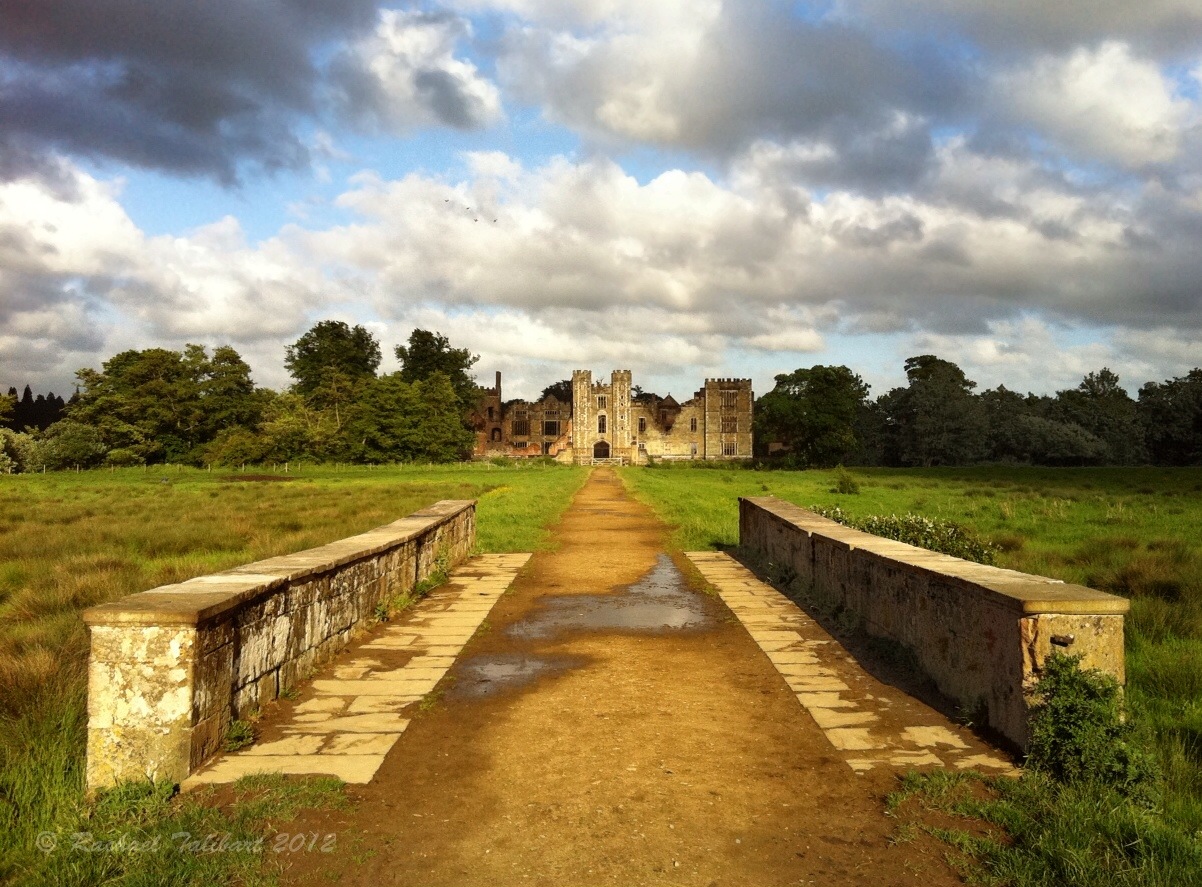
More iphoneography, this time taken today at Cowdrey Park ruins in Midhurst, West Sussex.

20120607-233050.jpg

This atmospheric building was once a magnificent Tudor house, visited by both Henry VIII and Elizabeth I.

20120607-233250.jpg

Today it is part of the Cowdrey Park Estate, probably most famous for being the home of British polo.

Guildford Castle

20120605-205447.jpg

Many eyes across the globe were turned towards our little island this weekend as we celebrated the Queen’s Diamond Jubilee. We may not be a very big nation geographically, or even in terms of power these days, but no one can deny we have a rich and long history. Among the signs of that history are the many castles that still stand right across the country. I do love a good castle so I thought I might do an occasional series about them.

20120605-223449.jpg

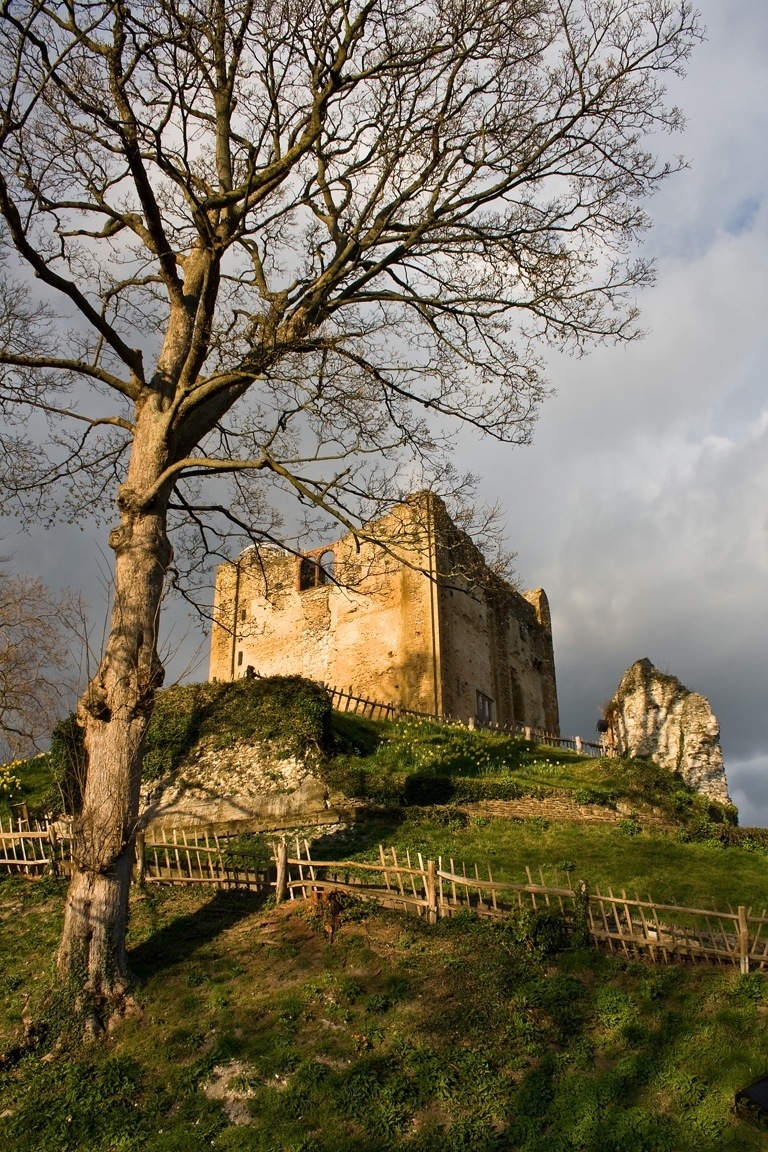
Guildford Castle is the closest castle to where I live. It was originally a Norman castle, built shortly after the conquest in 1066. Wooden defences were replaced with stone ones during the 12th century. As the only royal castle in Surrey, Guildford Castle became the centre for the county’s administration and justice and the keep, photographed here, housed the county gaol. However, after Henry III’s death in 1272, the castle fell into decline. In 1885, the ruins were bought by Guildford Borough Council. The keep has been renovated and now contains an interesting display about its history. The grounds are now a lovely park, full of beautiful flowers.

20120605-223539.jpg

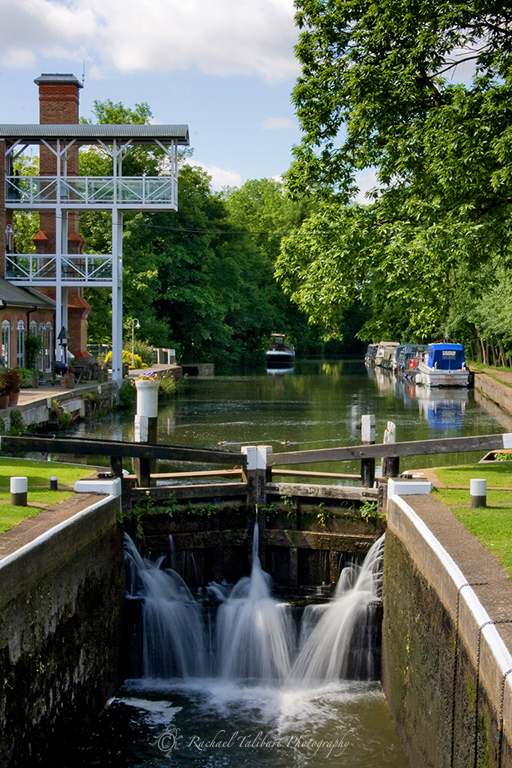
Walk this Wey: Thames Lock

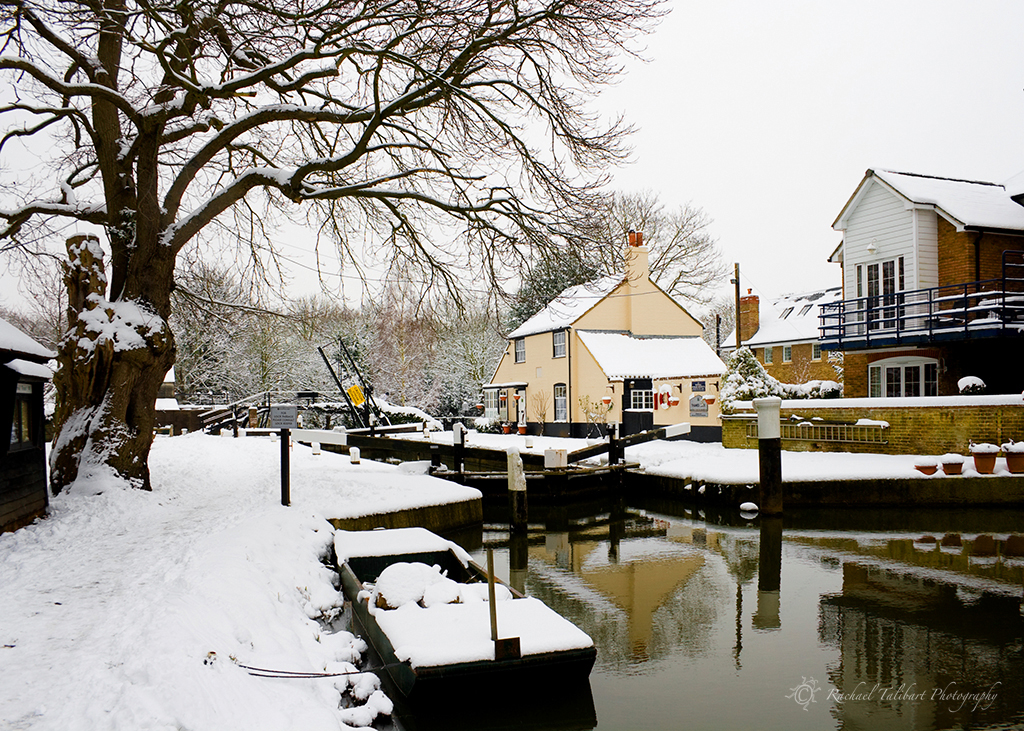
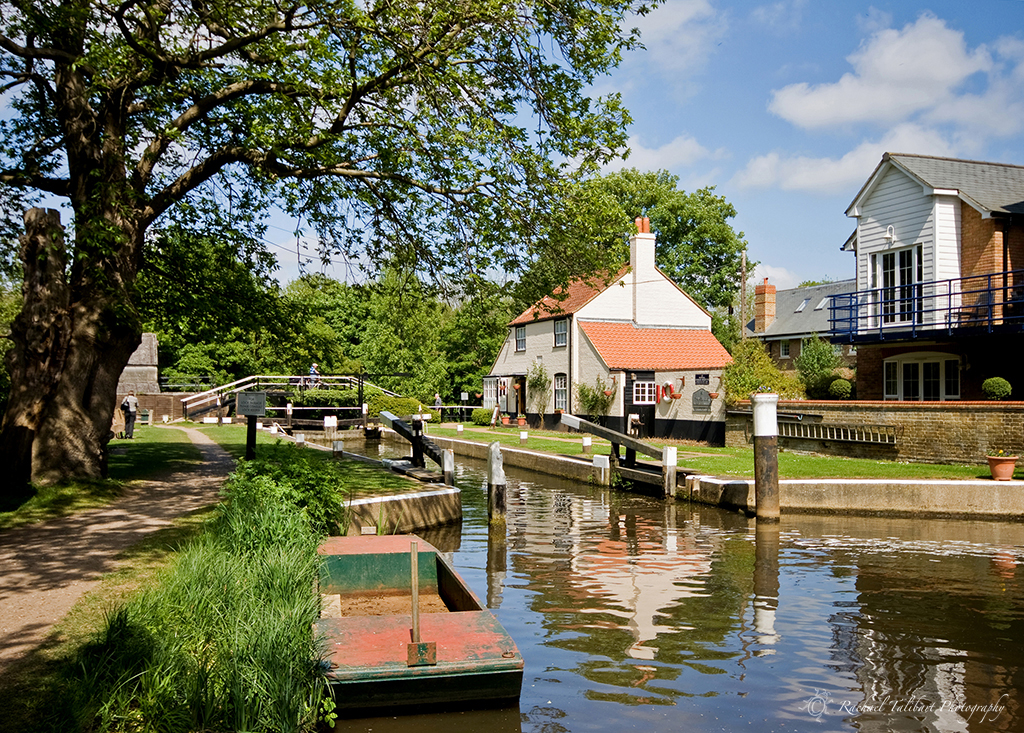
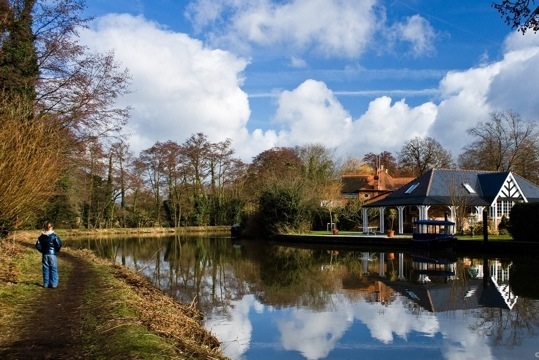
Today’s post is about one of my favourite local places, Thames Lock in Weybridge, Surrey. Thames Lock is the first lock of the Wey and Godalming Navigations.  One of Britain’s earliest man-made navigable waterways, the Navigations, which run for just under 20 miles from the Thames at Weybridge to Godalming, preceded the canal age by a century.  Now owned and managed by the National Trust, the Navigations and their towpath provide a tranquil green corridor through some of Surrey’s most built up areas and a pleasant, easy route through some of its loveliest countryside.
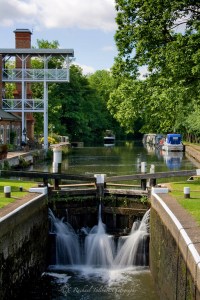
The Navigations were the brainchild of Sir Richard Weston of Sutton Place.  The first ten miles from the Thames were opened in 1653 and extended to Godalming by 1764.  The principal cargo was timber from Surrey’s forests destined for the shipbuilding yards on the banks of the Thames. But the Navigations were also an important route for the transport of wheat, flour and numerous other cargoes, including, in the early 1920s, a number of aircraft from Brooklands.  Today, the Navigations are plied by pleasure boats rather than commercial barges and the towpath is frequented by walkers and cyclists rather than the horses that used to pull the barges.

The entrance to the Navigations from the Thames at Weybridge is misleadingly insignificant in appearance, barely noticeable but for the sign on a post in the river.  Yet it is the location for an exciting passage in local writer, H G Wells’s classic, The War of the Worlds, which concludes as follows:

‘I staggered through the leaping, hissing water towards the shore.  Had my foot stumbled, it would have been the end.  I fell helplessly, in full sight of the Martians, upon the broad, bare, gravelly spit that runs down to mark the angle of the Wey and Thames.  I expected nothing but death.’  (1898)
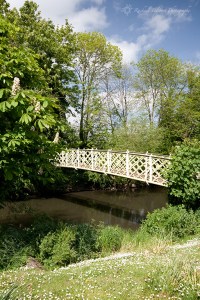
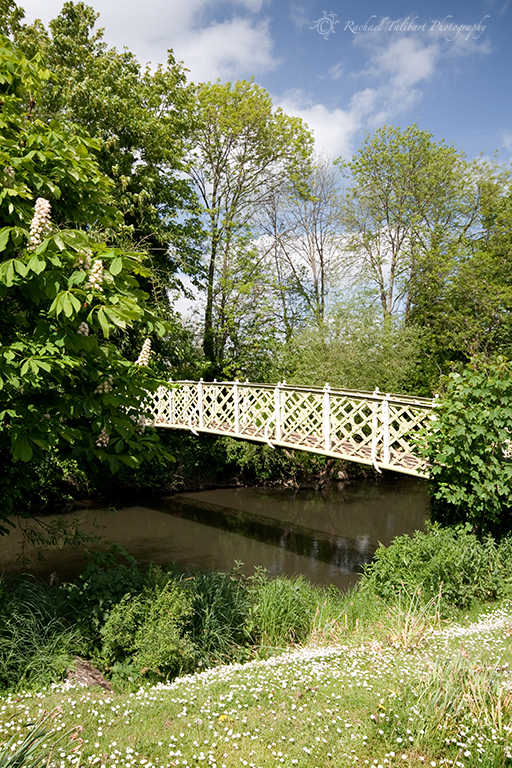
While not as challenging as evading Martian invaders, finding Thames Lock, where the towpath begins, can be difficult on foot.  A path, known as Church Walk, runs from the side of the Old Crown, a 17th century Grade II listed pub on Thames Street to Radnor Road.  The lock can be reached either via Jessamy Road, which bisects Church Walk or, further along Church Walk, via a small path to the right that leads over a pretty white and green footbridge.
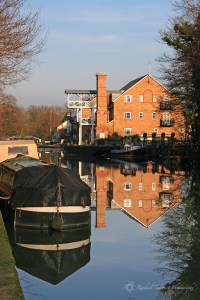
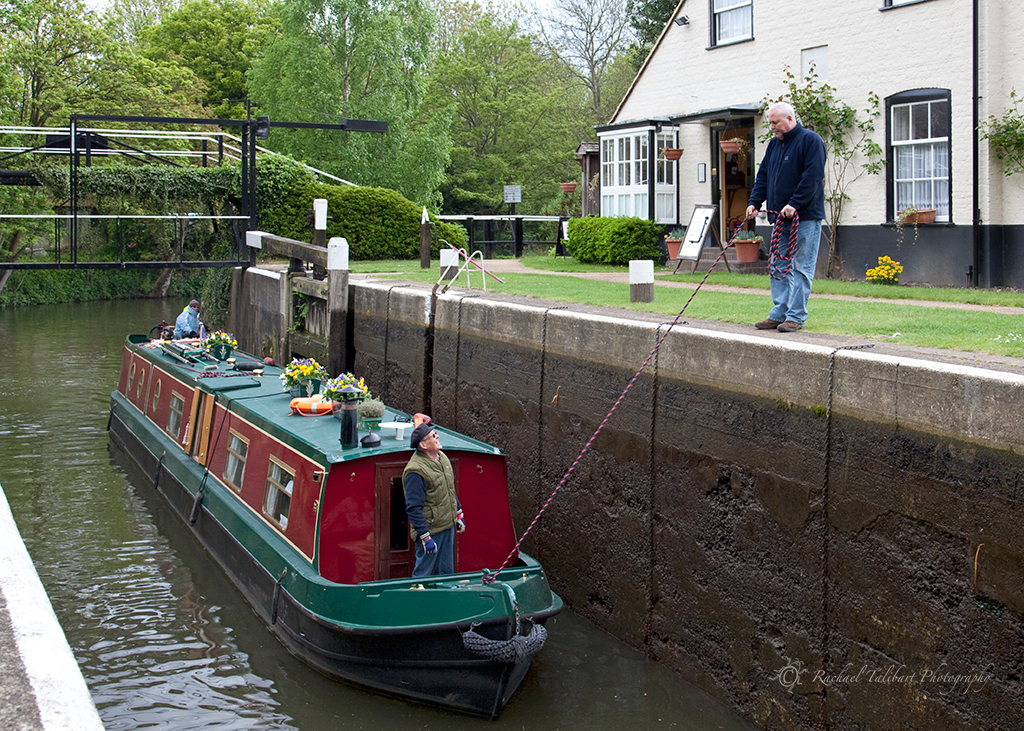
Both routes lead to Whittet’s Ait, an island between the River Wey and the Navigations.  If you follow the gravel footpath beside the public park there, you will come to the lock.  It is a delightful spot, with benches on which you can while away a few minutes or hours watching narrow boats negotiate the lock.   In spring and summer, planters outside the lock keeper’s cottage froth with flowers and it is not unusual to find a local artist at work capturing the idyllic scene.
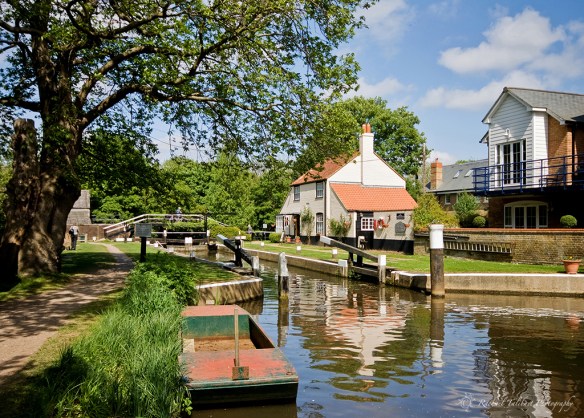
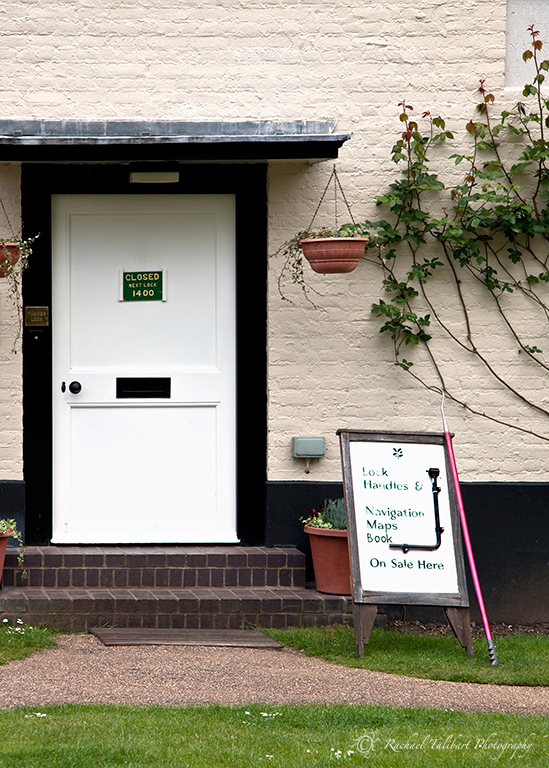
The towpath begins on the other side, accessed via an iron bridge over the lock. Before crossing, however, it is worth stopping at the lock keeper’s cottage where a free map can be obtained and you can buy a booklet of circular walks along the Navigations.

The present cottage was built by the National Trust in 1975 as a replica of its eighteenth century predecessor.   On the other side of the lock, beside the towpath, stand the stables that used to shelter the horses as they waited for the next barges to arrive.  Now they contain a small display on the history and wildlife of the Navigations.

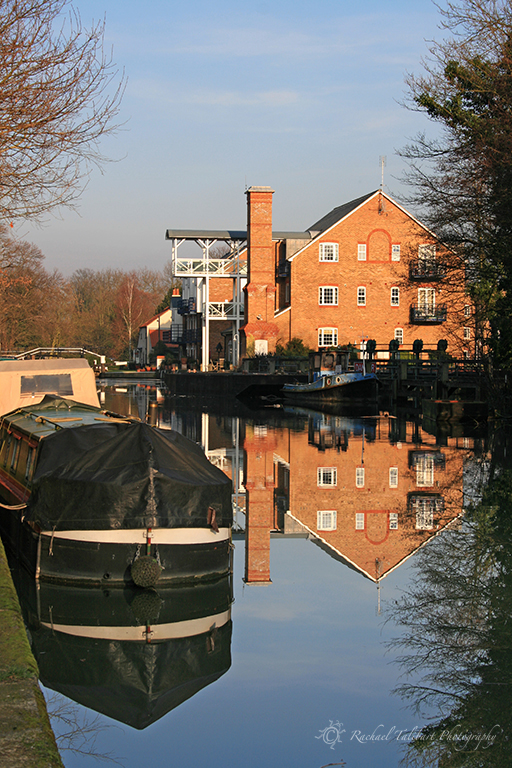
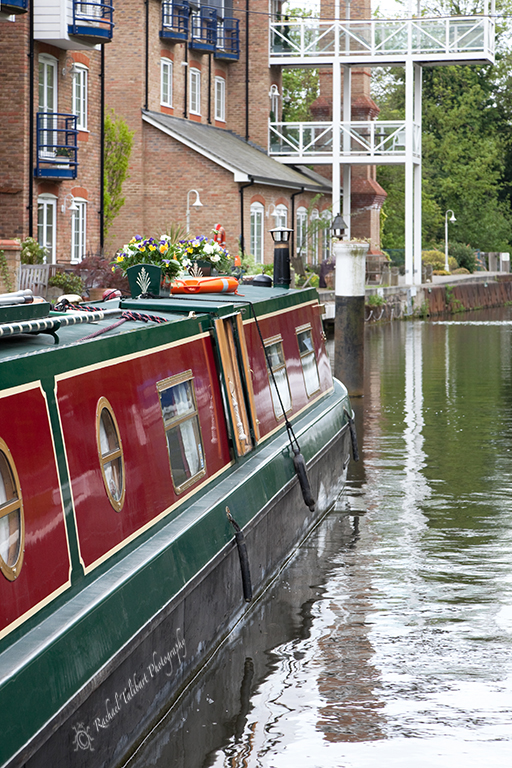
Next to the Lock stands a development of waterside apartments on what was the site of paper, iron and oil seed mills from 1791 to 1963 when the last of many fires on the site finally put paid to further milling.  One account of the fire describes how the water was alight with the highly flammable oil.
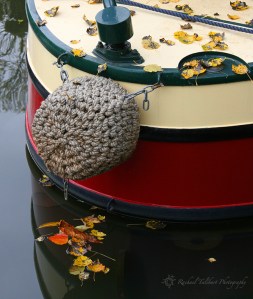
The Navigations are an important habitat for wildlife, from beautiful damselflies …

… to slightly more weird and wonderful critters.

You may even meet an occasional ship’s dog.


Admiring the view

20120524-122154.jpg

A short post today. This scene was taken on my local stretch of the Wey Navigation, a historic waterway that runs for 20 miles between Weybridge and Goldalming, Surrey. Last year I published a series of articles about the Navigation in some local magazines. The text (and some more images) of the first article which includes this picture is here. I will do a more detailed post on the Navigation, its history and wildlife, this weekend.

Little things

20120519-121056.jpg

Little drops of water,
Little grains of sand,
Make the mighty ocean
And the beauteous land.

And the little moments,
Humble though they be,
Make the mighty ages
Of eternity …

Julia Carney, ‘Little Things’ (1845)

Photo taken on the beautiful coast of Northumberland, England, with Lindisfarne Castle in the distance.

Rescues done

20120506-153029.jpg

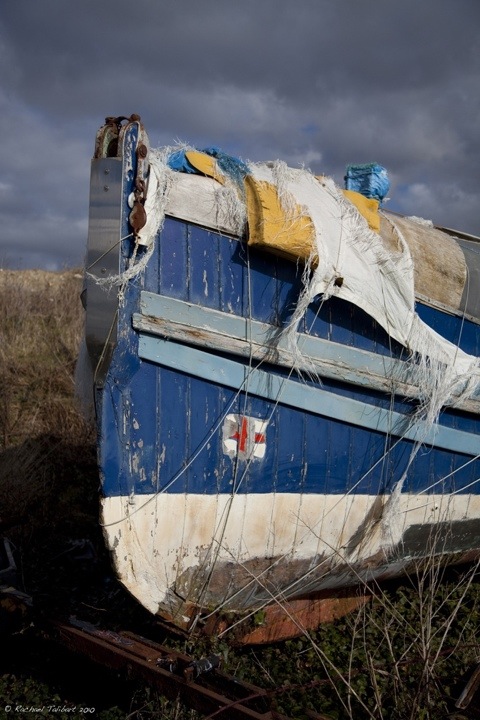
A couple of years ago we spent the weekend at Climping, near Littlehampton in West Sussex. On the west bank of the Arun at Littlehampton we found this old RNLI (Royal National Lifeboat Institution) lifeboat, gently rotting on the shore. I have always been interested in the story of the lifeboats and their crew. If you’re not from the UK, you may not know about this organisation staffed entirely by volunteers who freely give their time and risk their lives to save those in peril on the sea. The bravery of these men and women over the centuries is remarkable. I can’t believe no-one has made a blockbuster movie about them yet. I wonder what stories this boat could tell if it could speak.

Romantic runaways

Image

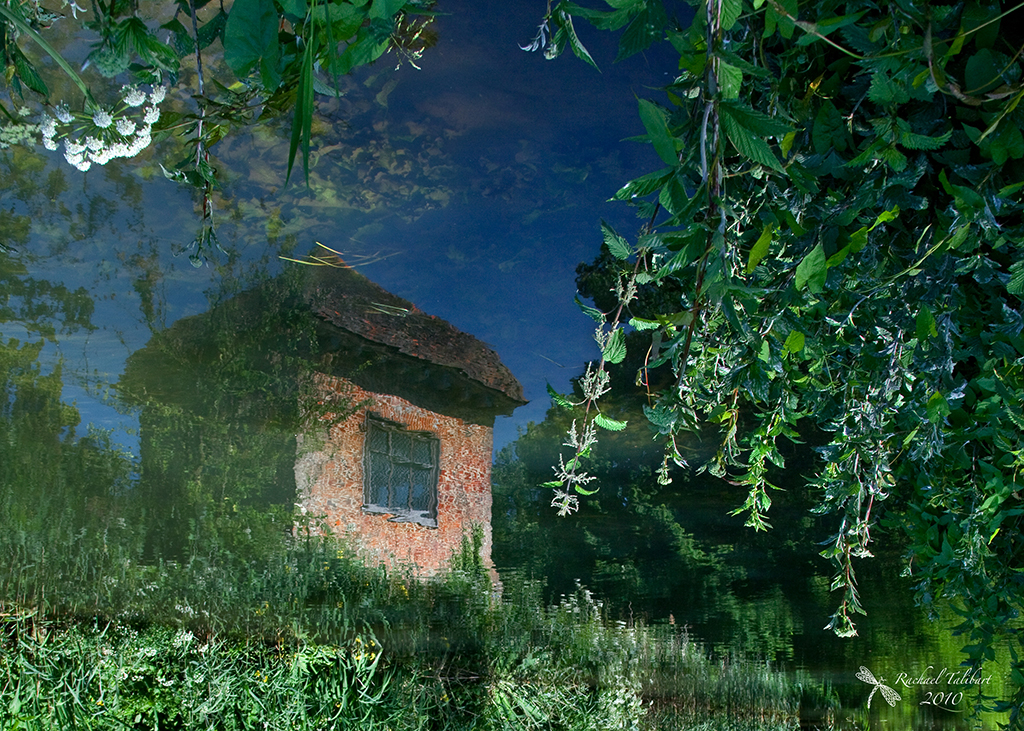
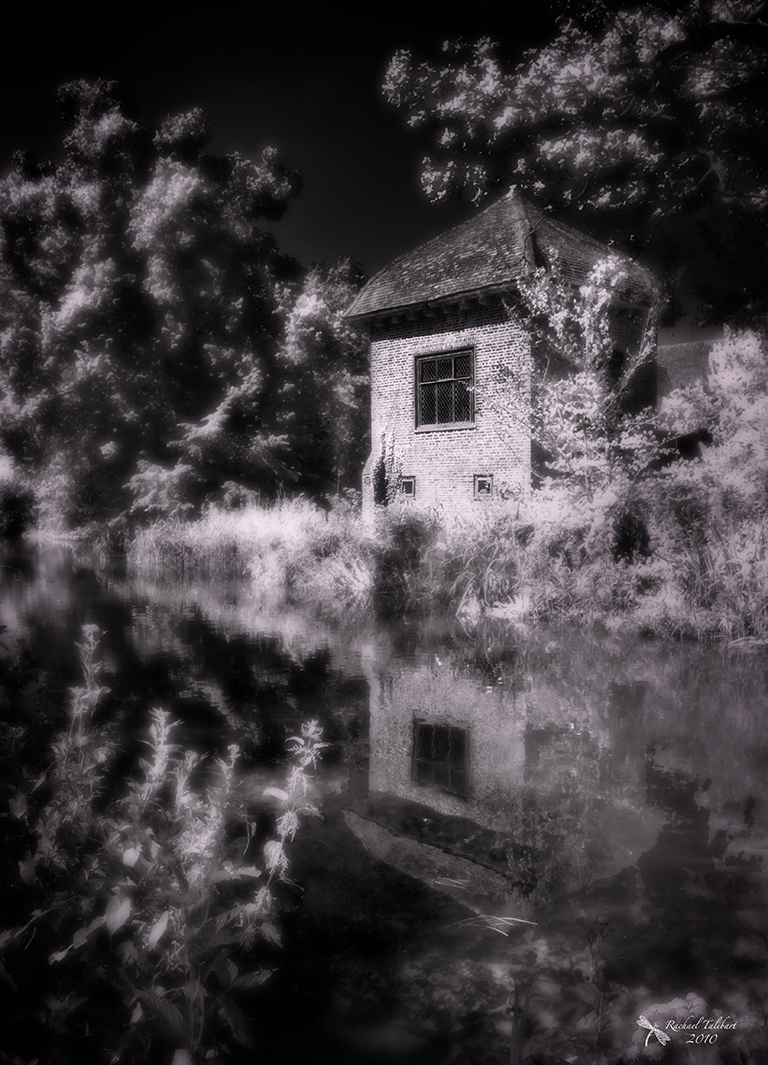
Last year I published a series of articles in some local magazines about the Wey Navigation, a historic waterway that runs for 20 miles from the Thames at Weybridge to Godalming, in Surrey, England. I thought I might occasionally feature excerpts from the series in this blog. Today’s excerpt is about one of the many interesting historical landmarks that can be seen from the towpath. This small brick tower can be found on the stretch between Pyrford Lock and Walsham Gates near the village of Ripley. It is an attractive and unusual structure, fourteen feet square, two storeys high with a first floor entrance and a distinctive ogee-pitched roof. Known as the ‘Summer House’, it bears a blue plaque declaring that: ‘John Donne, Poet and Dean of St.Pauls, lived here 1600-1604’. The story of the romantic runaways is about Donne and his passion for Ann More.

Image

Donne had fallen in love with Ann, the daughter of Sir George More of Loseley Park near Guildford. Ann’s family was too important for her to be permitted to marry Donne so the lovers eloped, when Ann was only 17. This caused a scandal and Sir George organised a search for the runaways. Once they were found, Sir George had Donne thrown into London’s Fleet Prison. On his release, he and Ann were given shelter at Pyrford Place, the home of Sir Francis Wolley, a friend of Donne’s. Sir Francis eventually managed to engineer a reconciliation with Sir George. John and Ann Donne lived at Pyrford Place for a further two years and had the first of their twelve children there. Ann and children lived there for another year while Donne travelled, before the whole family moved to their own home in 1606. It is said that, such was his love for Ann, Donne never got over his grief when she died (having 12 children took its toll!).

It seems unlikely that Donne ever actually lived in the Summer House, which some historians think may not even have been built until later in the century, but the Summer House is in the grounds of Pyrford Place and it is certainly picturesque enough to stand in the imagination as the retreat of a lovelorn poet!

All other things, to their destruction draw,
Only our love hath no decay;
This, no tomorrow hath, nor yesterday,
Running it never runs from us away,
But truly keeps his first, last, everlasting day.

Songs and Sonnets (1611) ‘The Anniversary’

The full text of my article and some more of the images can be viewed here.