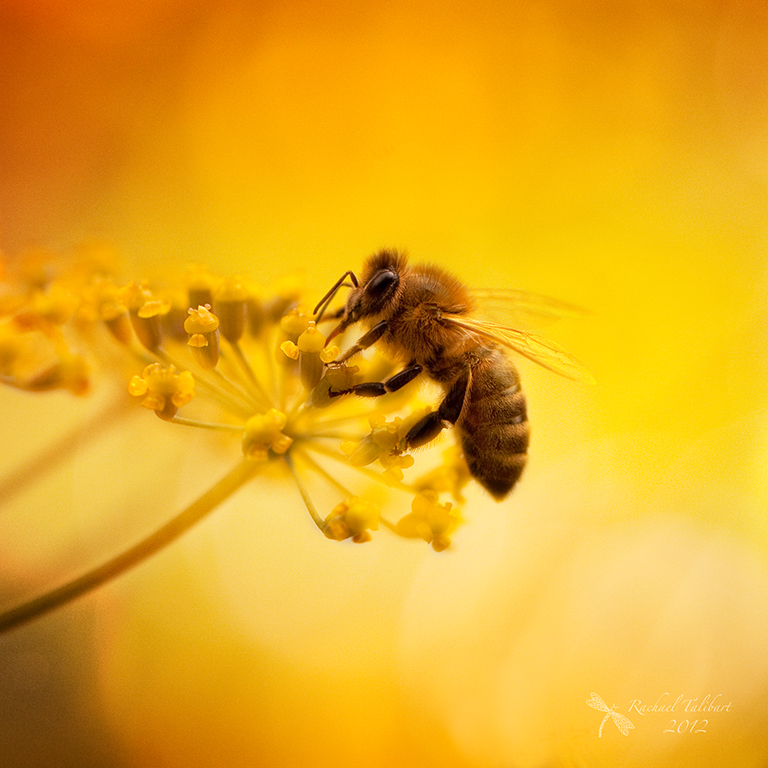
I hope you like this image I made this morning of a honey bee on fennel. I only have two fennel plants in my garden but they punch well above their weight when it comes to attracting insects.
Summer and the honey bee
18

I hope you like this image I made this morning of a honey bee on fennel. I only have two fennel plants in my garden but they punch well above their weight when it comes to attracting insects.
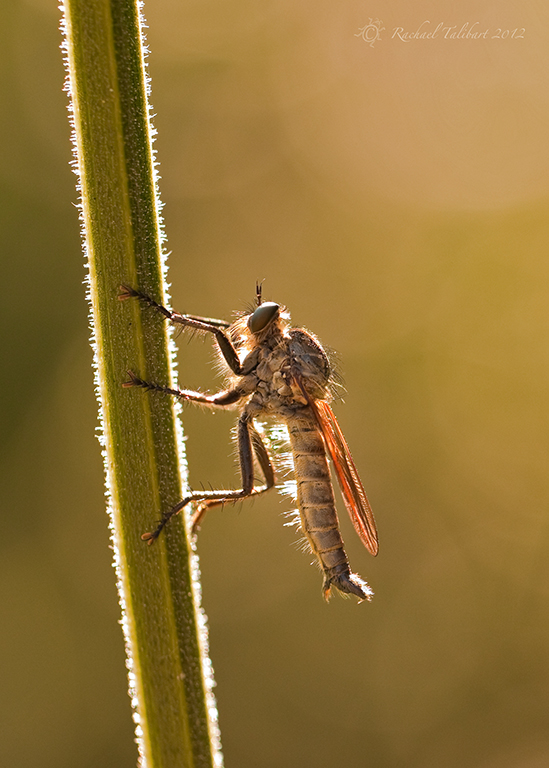
This fine fellow is machimus atricapillus, the Robber Fly. He perches waiting for a hapless and punier insect to fly by and then darts out – game over. He is not fussy in his choice of perch, even making use of handy humans, but he does not bite people. Here, he is enjoying a spot of evening sun in my garden.
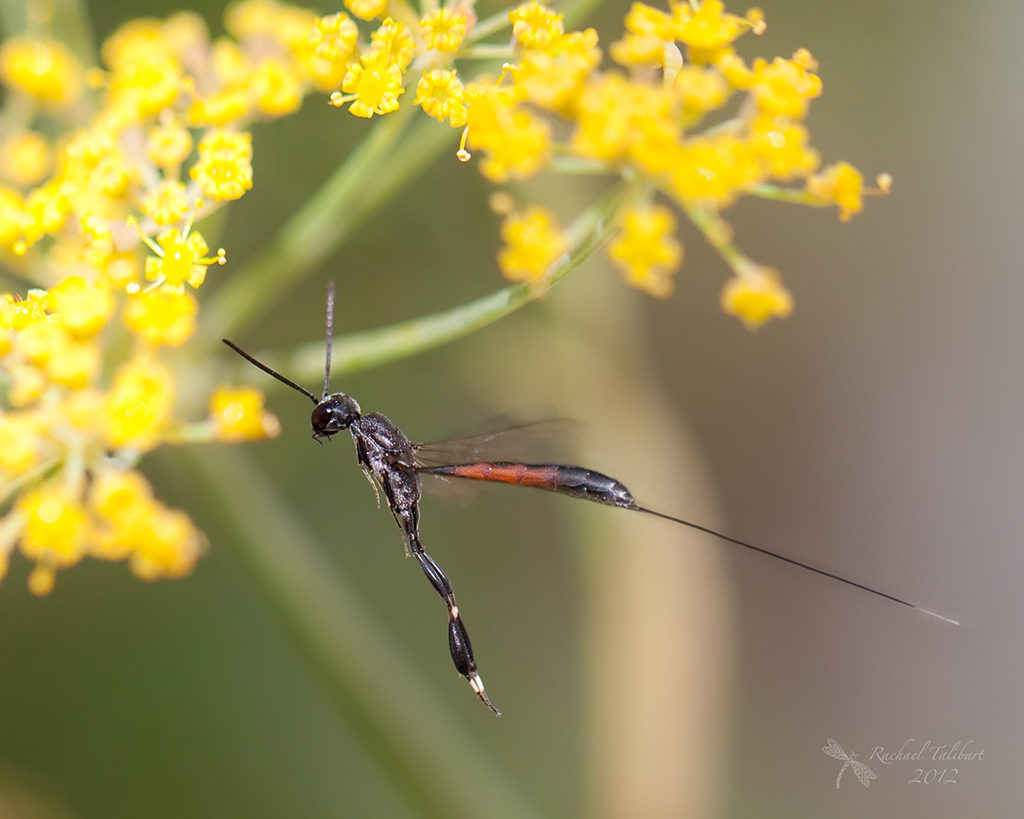
This bizarre creature is gasteruption jaculator. Whoever named it should be banned forthwith from all future namings. I am grateful to afrenchgarden for the I.D. I was wrongly was calling it a sand digger wasp. I have never seen one in my garden before this year. Yesterday I noticed one feeding on fennel pollen but was unable to get a decent shot before it flew away. So, today, I returned to the fennel plant at the same time of day and, low and behold, there it was. And I was delighted to be able to capture it in flight!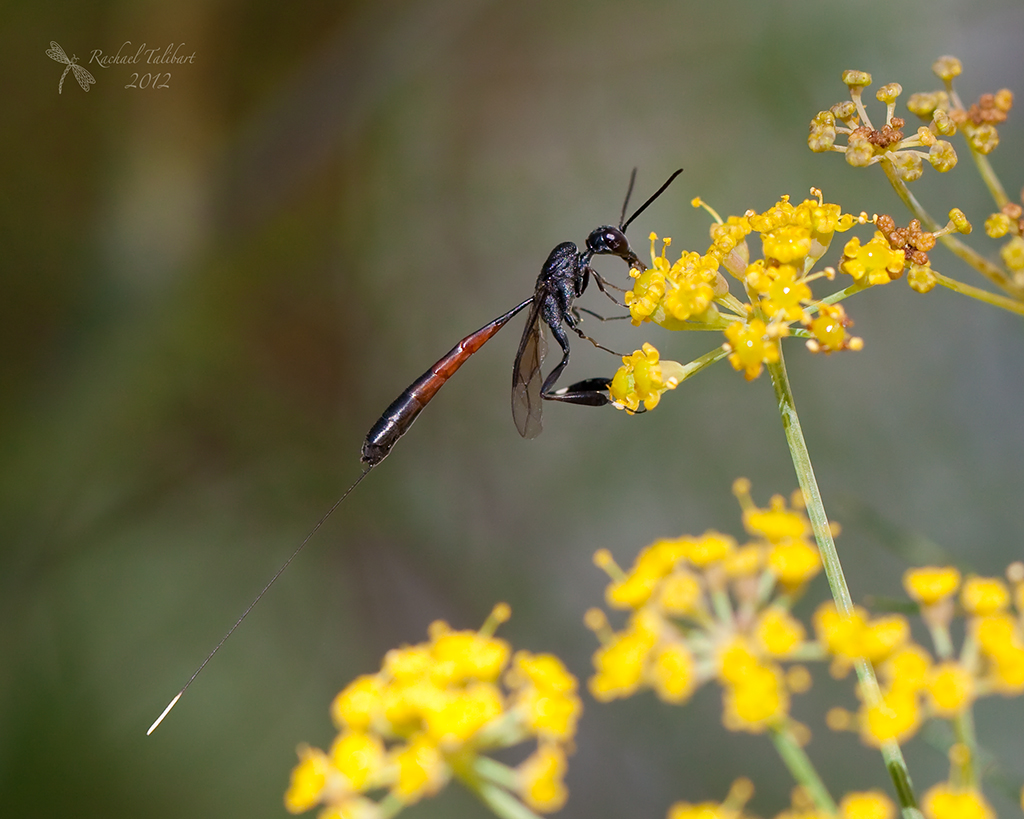
It is an elegant creature with its long spike looking not unlike a cigarette holder from the 1920s (or is that just me?). I am assuming this is the female. Her consort, a much smaller beast without cigarette holder, is below. (It’s a lousy shot, I know, but illustrative.)

For an earlier post on other wasps found in my garden, see here.
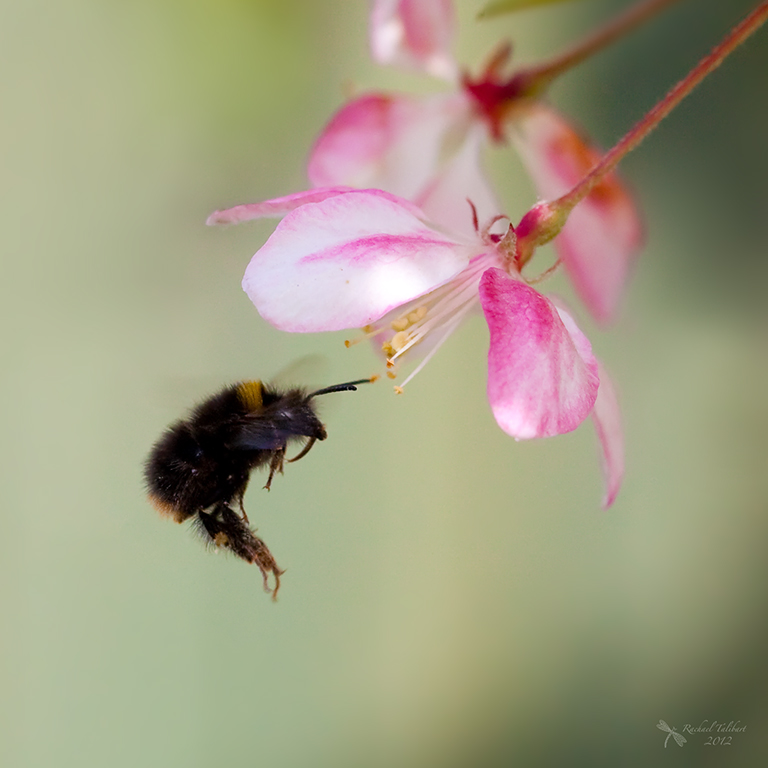
One of my faults as a photographer is my workflow management. I snap away, loving the moment, upload a host of shots, pick the best one of the day and leave the rest to languish, neglected on my hard drive. But sometimes I happen across a rejected shot and find I like it. Perhaps such happy accidents make the chaos worthwhile. Anyway, this afternoon I happened across this forgotten shot from the Spring, and I was glad.
Do you live, like me, in a state of photographic disorder, or are your files neatly honed, indexed, and double backed up?

One of the many interesting insects I snapped for the first time last year was this hoverfly. It’s a whopper and if you don’t know your hoverflies from your hornets, rather scary. This critter is designed to mimic the European Hornet, and it does a good job! Apparently this one is a male. Yes, I can now sex hoverflies – is there no end to the fairly useless and geeky things I am learning through photography?
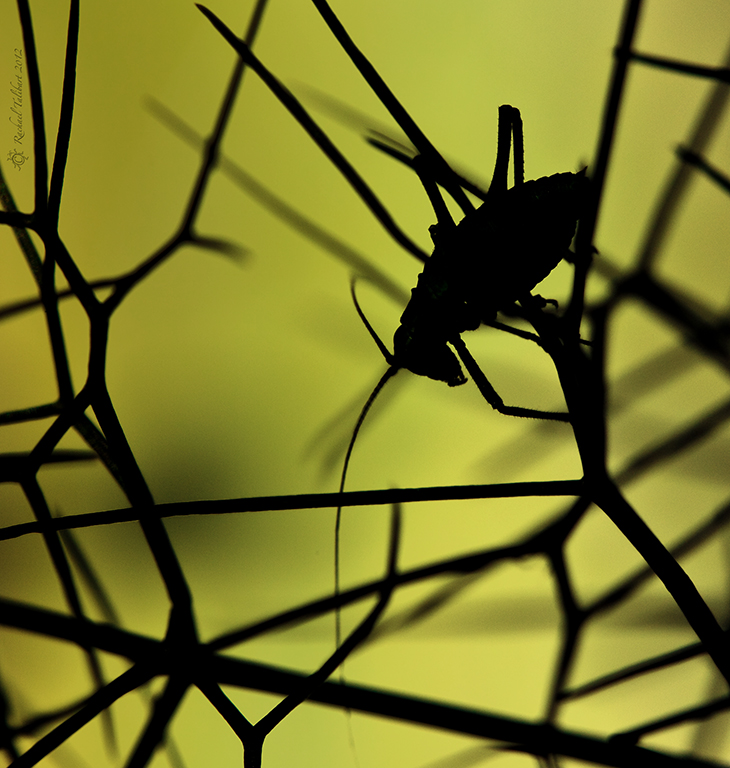
Regular readers will know that I have been following the antics of some speckled bush cricket nymphs in my garden. From cute first hatchling through inquisitive early instar stages to greedy adolescence and approaching adulthood. And what do I get as a reward for bringing them fame and adulation? Plants with holes! I counted at least 25 of the devils out there yesterday, nibbling away at my carefully nurtured dahlias. Have they no gratitude? The youth of today (sigh)! So a suitably more sinister image of one of the little monsters today. And now I have a dilemma…
Whoever struggles with monsters might watch that he does not thereby become a monster. And when you stare into an abyss for a long time, the abyss also stares into you.
Friedrich Wilhelm Nietzsche Beyond Good and Evil (1886)
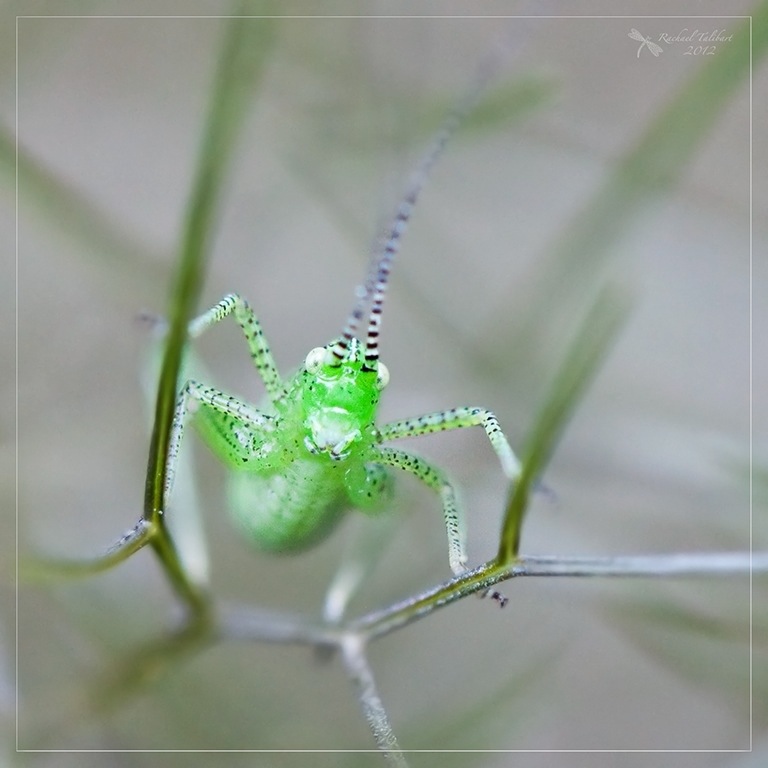
It’s been a couple of weeks since my post about the little speckled bush cricket nymph I found in my herb border. It’s still there, lurking in the fennel, along with three chums. As you can see, it has developed quite a bit in that time and is starting to look a little more like the adult it will become.

Incidentally, when I posted my earlier shot of the nymph on Flickr I received a rather picky comment to the effect that it was a shame I had failed to capture it facing me. Ahem, full frontal enough now? 😉

A freshly hatched nymph looks out on a new world.
I was pottering around the herb garden looking for some buggy subjects for my ever-hungry macro lens when I thought I saw a greenfly. Closer observation revealed this pretty little speckled bush cricket nymph. Speckled bush cricket (leptophyes punctatissima) nymphs shed their skins six times. Each version is called an instar. I think this tiny nymph is a newly emerged first instar.
The full adult version, as pictured below, can be found in the garden from about late July onwards. I have found the little nymph in the same place every day since I took its picture. I will follow its progress and try to get some more shots as it grows.
For more information on speckled bush crickets and some super shots see this blog.
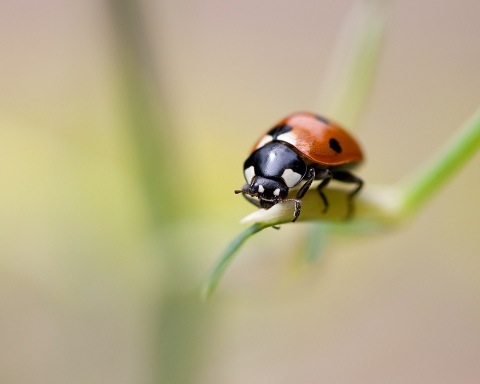
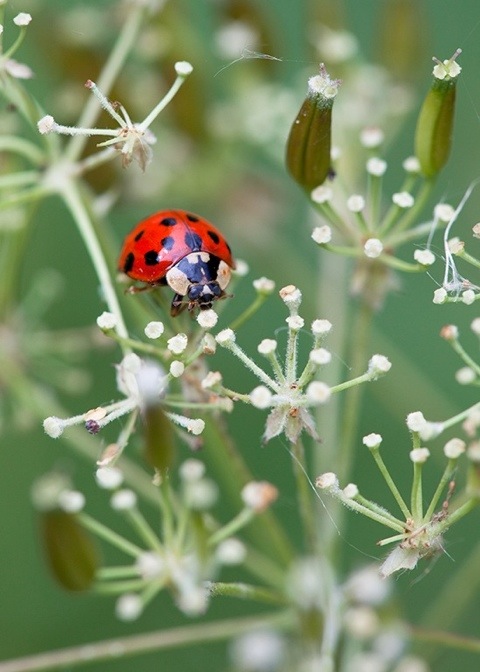
The last in my mini-series about the aphid, ant, ladybird relationship, is the top predator, the ladybird, or ladybug if you are American. Ladybirds are beetles of the family coccinellidae. They are probably the most easily recognisable beetle thanks to their characteristic bright colouring.

Of the world’s 3500 species of ladybird, 46 live in Britain. Probably the most common is the seven-spot ladybird, coccinella 7-punctata.
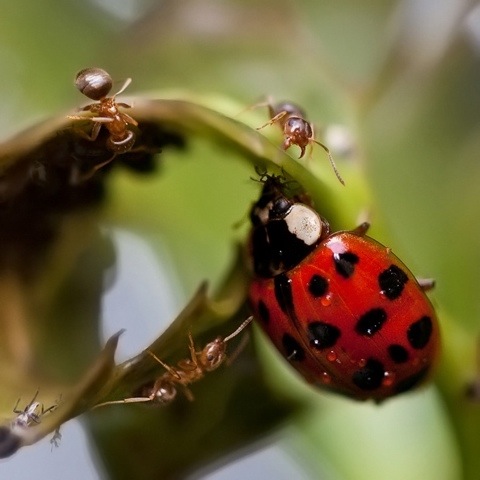
Although many types of ladybird will eat other insects, their favourite meal is aphids, which they will hoover-up without being in the least deterred by ant-shepherds.
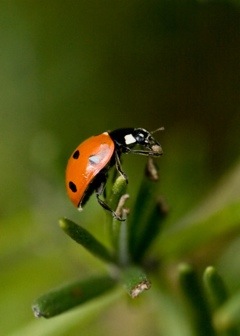
May is the main month for ladybirds to mate.
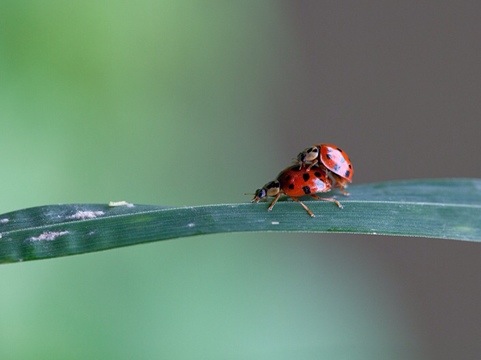
In recent years, Britain has seen an influx of the Harlequin ladybird, harmonia axyridis. This large ladybird is considered to be a potential threat to indigenous species. It is a voracious hunter and its larvae will eat the larvae and pupae of other ladybirds. It may also mate with indigenous species.

The Harlequin is difficult to identify accurately because its colours vary so much. I think, however, that in the picture above, both ladybirds are harlequins, despite their very different appearances. One clue is that Harlequins usually have brown rather than black legs.

Ladybirds hibernate through the winter. Here a group of harlequins sleep huddled together.

Somewhere on my hard drive are images of ladybird larvae and pupae. When I find them, I will add them here. In the meantime, I leave you with the well-known nursery rhyme:
“Ladybird, ladybird, fly away home
Your house is on fire,
And your children are gone”.
No bugs tomorrow, I promise!

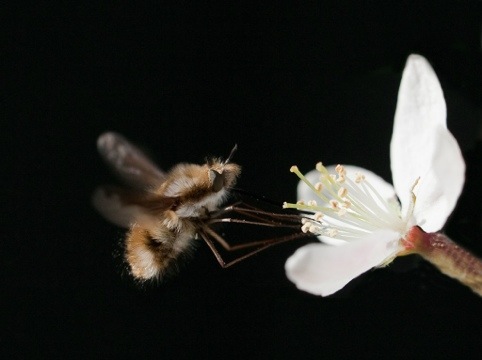
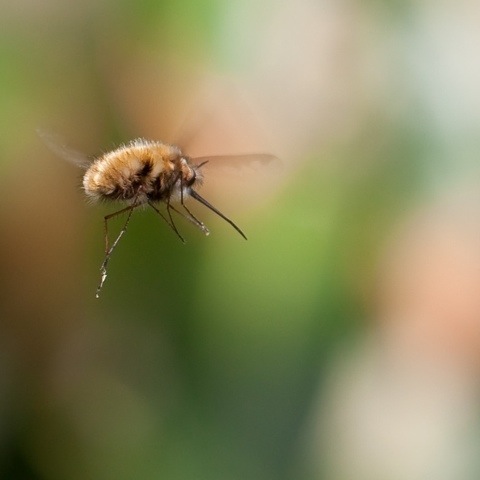
The subject of my natural history post for this week is the bee fly or bombylius major. This bee-mimic is common in my part of the world (Southern England) in early spring.

Its rather imposing appearance can lead people to assume that it is dangerous but it cannot harm you: that long proboscis is merely a very efficient nectar guzzler. In fact, I think the bee fly is rather cute. Just me, perhaps.

They certainly look quite cute on the wing, with their spindly legs flying out Superman style from the chubby body. However, while they may not be harmful to humans, they have a sinister life cycle if you happen to be a bee.

This bee mimic lays its eggs by the nests of solitary bees. When the larva hatches, it uses a crown of spines on its head to batter its way into the cell of the bee pupa and slowly sucks the pupa dry.
Afterwards, the gorged larva pupates and finally emerges in its final form by battering its way out of the cell.

Needless to say, I have not been able to take photographs of the full life-cycle, just the disingenuously cute, fluffy fly.
For some more (and frankly better) pictures and two poems (yes!) about bee flies, visit my friend Giles Watson’s Flickr photostream. The second poem (which treats the life cycle) appears in a comment there.
PS Some of the images appear pixelated here. They do not in the files I uploaded. If anyone knows what I’m doing wrong, please can you help? It’s a shame for them not to appear their best.
 Focused Moments