Bamburgh Castle

20120821-185325.jpg
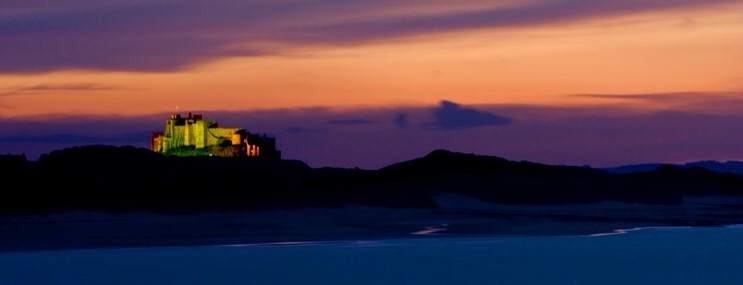
Several people have recently asked me about the header image for this blog. It is Bamburgh Castle in Northumberland. In August 2009, we spent a very enjoyable week in Northumberland, England’s most Northern county and its most sparsely populated. Even in the midst of the summer holiday season, it was easy to find peace and solitude.
20120821-181006.jpg
We stayed in Seahouses, just down the coast from Bamburgh, and with spectacular views of the iconic castle. Despite Northumberland’s reputation for terrible weather, we had a week of sunny days and, every night, spectacular sunsets.

20120821-185603.jpg
Bamburgh Castle stands on a basalt outcrop. The first written record of a fort on the site dates from 547CE but a fort had probably been there for at least a century. The Vikings destroyed the original fort in 993. At the heart of the present castle stands a Norman structure. Further building took place over the next several centuries but the castle finally fell into neglect in the 1700s.

20120821-183552.jpg
The Victorian industrialist William Armstrong completed restoration of the castle and it is still owned by the Armstrong family. It is open to the public and has also been used as a location for several movies, including most recently the 1998 film, Elizabeth.

20120821-184251.jpg
If you are ever in the area, Bamburgh Castle is well worth a visit, but beware: last admission is at 3.30 and the castle closes at 5 but the staff were so eager to get home that they started clearing us out at 4.30. An hour is most definitely not long enough to see the castle and admission is not especially cheap!

The Cobb

20120719-202639.jpg
Our summer holiday this year will be spent at Lyme Regis, a lovely little town on the coast of Dorset. It is steeped in history and features in Jane Austen’s Persuasion:

the principal street almost hurrying into the water, the Walk to the Cobb, skirting round the pleasant little bay, which, in the season, is animated with bathing machines and company…are what the stranger’s eye will seek

20120719-205310.jpg

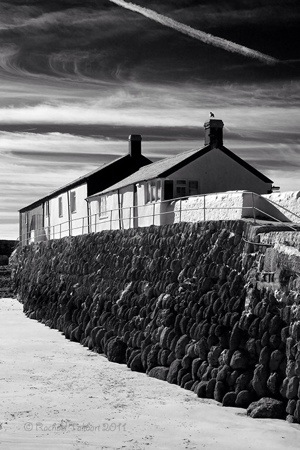
The Cobb is Lyme Regis’s famous harbour wall. In Persuasion, one of the characters takes a tumble off the Cobb. In a later novel, The French Lieutenant’s Woman, John Fowles immortalised “quite simply the most beautiful sea rampart on the south coast of England”.

20120719-205820.jpg

Lyme Regis is on The Jurassic Coast, a World Heritage Site for its wealth of fossils from the Jurassic period. It was here that Mary Anning (1799-1847) discovered, at the tender age of twelve, the first complete ichthyosaur. She went on to become a renowned palaeontologist when the science was in its infancy. Lyme Regis Museum, a fascinating place to visit in its own right, is built on the site of Mary’s home.

20120719-210853.jpg

Reigate

20120618-140446.jpg

We spent yesterday in Reigate, a quiet market town in North Surrey. The only camera I had with me was my iPhone so, in the true tradition (if there has been enough time for there to be a tradition) of iPhoneography, I have lightly edited the images on my iPad and uploaded directly from there.

20120618-140821.jpg

Reigate has the remains of a castle so I get to continue my series on castles. The castle was built in the eleventh century and fell into decay in the seventeenth. None of the stonework remains but the earthworks have been turned into a pretty, and peaceful garden.

20120618-142555.jpg

Underneath the castle gardens is a network of caves. The most well-known, The Barons’ Cave, is reputed to have been a meeting place for the barons who devised the Magna Carta. The stone pyramid in the top photographs guards an underground
sallyport.

20120618-142133.jpg

The few remains of the castle were removed in 1777 when the land was converted into a garden. The mock medieval gateway was built at that time.

We thoroughly enjoyed our day in Reigate. The town has a lot of interesting independent shops, a fine array of eateries and an Everyman cinema (in which we saw Prometheus). Best of all, the sun shone: a rare event here this summer!

20120618-142916.jpg

The Cathedral of the Thames Valley

20120610-113643.jpg

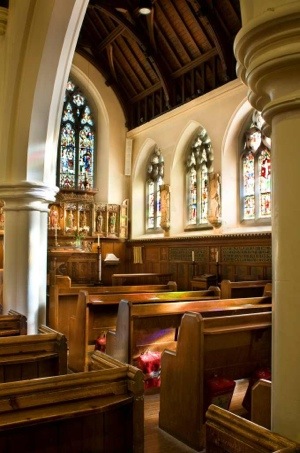
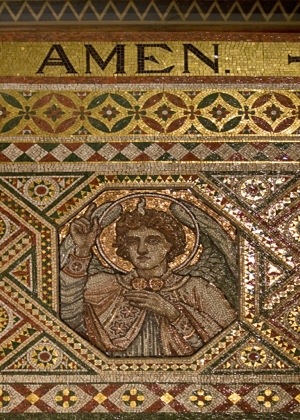
A view of St.James’s, a beautiful Victorian church in Weybridge, Surrey designed by Sir John Loughborough Pearson. This is a series of shots I took in 2009 pro bono to support the renovations work of The Friends of St.James.

20120610-113740.jpg

The Church of Saint Nicholas stood on this site from 1175 until the middle of the nineteenth century. St Nicholas’s was demolished in 1846 and a rebuilding programme was commenced.
The new church was dedicated to Saint James and was consecrated in 1848. Seven years later the Spire was completed, and in 1864 the South Aisle was built. A further eleven years would pass before, in 1875, the ‘Eight Bells’ were dedicated.

20120610-114018.jpg

Finally, in 1889, the Chancel was enlarged and the outer South Aisle was added; it was also at this time that the height of the Chancel was increased by roughly ten feet which gave a better harmony to the overall proportions of the building. The interior of the church is a lovely example of arts and crafts design.

20120610-114116.jpg

Installed in the West face of the south aisle is the Sacramental Window. Made from Victorian stained glass, it is probably intended to depict the sacraments of the church. This important window is made after a design by the celebrated pre-raphaelite, Edward Burne-Jones.

20120610-114250.jpg

St.James’s is the work of John Loughborough Pearson. Pearson, 1817-97, was a Gothic Revival architect renowned for his work on churches and cathedrals. Pearson revived and practised the art of vaulting, and acquired in it skill unmatched in his generation. St.James’s has been described as the ‘Cathedral of the Thames Valley’.

20120610-114523.jpg

20120610-120708.jpg

20120610-120756.jpg