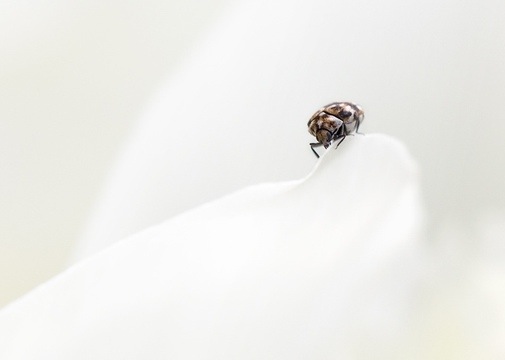
The little bug that could

20120514-203412.jpg

Welcome to the second instalment of my three-part series on the aphid, ant, ladybird relationship. If you don’t like ants, look away now!

20120514-203641.jpg

Less than .5% of the world’s species of ant live in the UK. It is mostly too cold and wet for them, something not difficult to believe given the spring we’re having! By far the most common is the black garden ant, Lasius Niger.

20120514-203743.jpg

These tough, fast, little ants live in colonies of up to 15,000. They eat insects, seeds, nectar and even the bodies of their own dead.
20120515-085529.jpg

As illustrated in an earlier post, they have a particular liking for the sticky honeydew secreted by aphids and will climb bushes to “herd” aphids, protecting them from predators. They obtain the honeydew by stroking the aphids with their feelers!
20120515-085723.jpg

On certain still, warm days each summer, males and queens will emerge from the nest and take to the wing, mating in flight. The queens then shed their wings and start new nests. The males, their sole purpose fulfilled (if they are lucky), die. Environmental cues lead to all the nests in a locality releasing their males and queens at the same time. This enables inter-nest mating, ensuring genetic diversity.

20120515-085824.jpg

The study of ants is called myrmecology. This made me think of Achilles’ myrmidons so I looked up the etymology of the word and learned my new thing for the day! According to myth, Zeus made the Myrmidons from a nest of ants. Another meaning of myrmidon is a faithful follower who carries out orders without question.

20120515-085903.jpg


“Next time you’re found, with your chin on the ground,
There’s a lot to be learned, so look around.

Just what makes that little old ant
Think he’ll move that rubber tree plant?
Anyone knows an ant, can’t,
Move a rubber tree plant.

But he’s got high hopes, he’s got high hopes,
He’s got high, apple pie, in the sky hopes.

So any time you’re gettin’ low,
‘Stead of letting go,
Just remember that ant,
Oops there goes another rubber tree plant.”

“High Hopes” Cahn/Van Heusen

Aphids of every hue

20120514-093533.jpg

A few weeks ago, I told a story about a conflict between three species of minibeast in my garden. This week, I thought I might take three days to focus on each of those same three species individually. I promise to do something non-buggy on Thursday.

I am starting with the bottom of the food chain, the lowly aphid. The top image is hot off the presses, taken in my garden yesterday. We actually had some sun this weekend! Back to rain today though. Anyway, I call it “Bringing up Baby”. Babysitting is such hard work, especially when the toddler will keep running away from you!

20120514-094154.jpg

Aphids are a lot less attractive in numbers, especially when sucking the life force from one of my rose bushes. The picture above makes me think of sci-fi and contagion-style movies. Euch.

20120514-094403.jpg

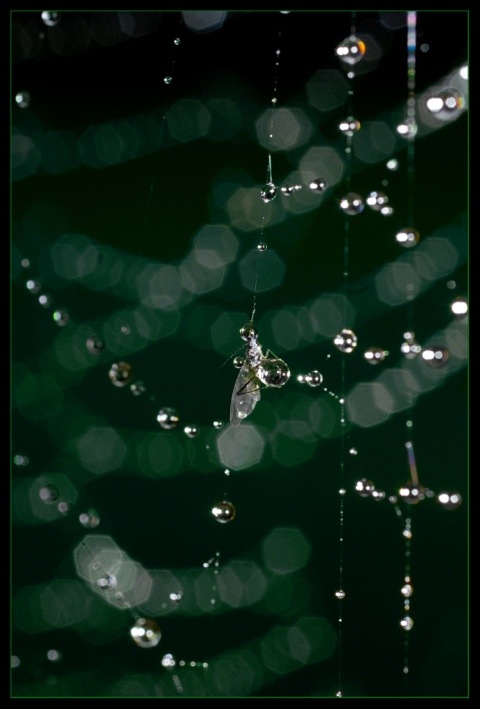
Still, aphids are a vital part of the garden food chain, like the wildebeests or antelopes of the African plains. I call the shot above “The Bubble Trap”. A blackfly is caught in a double trap of web and water droplet.

Here’s another capture of the same doomed aphid:

20120514-094659.jpg

All that is left of the aphid in the next shot is a single wing:

20120514-100721.jpg

Singly, however, the greenfly remains an unexpectedly graceful creature, its delicate form suggesting vulnerability:

“He didn’t want to stop cutting, and hacked away so furiously that he shook with the vibrations, wedged between his two levels of rock, like a greenfly caught between the pages of a book which threatened to slam suddenly shut.”
Emile Zola, Germinal, trans. Peter Collier

20120514-102802.jpg

Tomorrow, it’s the aphid farmer’s turn, the garden ant. I bet you can’t wait. 😉

Feeling waspish

20120503-095102.jpg

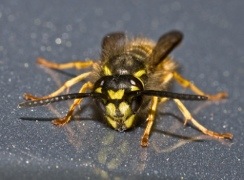
There are many different types of wasp in the UK. The one we all know is the common wasp (above), the ruin of many a barbecue in summer and autumn. I call this shot, “Mirror, mirror on the wall”.

20120503-102153.jpg

Common wasps are social wasps, living in colonies. There are also many different types of solitary wasp, that dig burrows and, very often, have a parasitic life-cycle, such as the wasp in the next picture.

20120503-095412.jpg

Your eyes are not deceiving you; this wasp is indeed pulling the legs off a spider! It is a type of spider wasp of the family pompilidae. (Identification for an amateur is not straightforward but I think this is probably pompilus cinereus.) They find a spider, paralyse it with their sting, and drag it back to their burrow. Then they lay an egg inside the spider. Once the egg hatches, the larva eats the spider alive, from the inside out. Sometimes, if the spider is too big for the burrow, the wasp will pull its legs off. The expression, “feeling waspish”, takes on new significance!

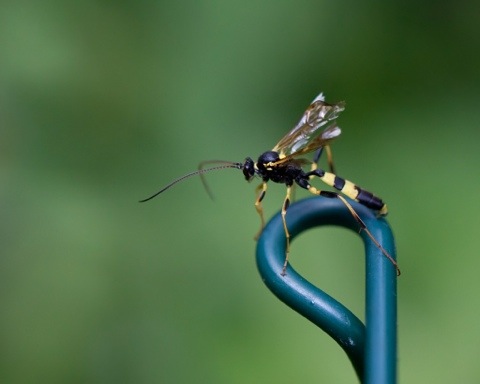
Some wasps have an elegance about them, like the slim-waisted society belle below. Hence the expression, “waspish figure”.

20120503-100628.jpg

I think this is probably a type of digger wasp. This one has a damaged wing, which is why it stuck around long enough for me to get a shot off. Do not be fooled, however, by its stylish gown and slender grace. If my identification is correct, this beguiling debutante is parasitic too; the female lays its eggs in flies. Waspish in appearance and intent.

In flight entertainment

20120425-094552.jpg

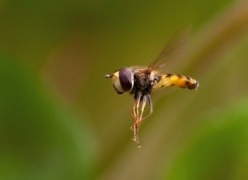
One of my photographic obsessions in the last couple of years has been capturing insects in flight. Particularly bees and hover flies. I have by no means mastered this art yet. But I have bagged a few shots that I like and I have learned a few things along the way.

20120425-094844.jpg

I suspect that the best way to get really superb shots is to find a flower that the insects frequent, set up the tripod, lock focus on the flower and use a remote shutter release to fire off a load of shots every time a bug comes near. I can see the attraction of this laid back approach. I imagine a deck chair, comfy cushions, a cool glass of Pimms… But you would need that kind of still summer’s day that only happens in this country in Evelyn Waugh novels. Even the slightest breeze can move a flower. So, ditch the tripod.

20120425-095550.jpg

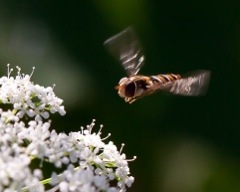
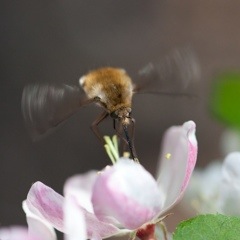
I prefer to shoot flying bugs in shutter priority, set to 1/640 or 1/800, with the camera set to AI servo and continuous shooting. Any faster than 800 and you risk freezing the wings. I prefer blurry wings. They’re moving, and I want my picture to show that. Compare the two shots below:

20120425-095804.jpg

20120425-095840.jpg

The first shot is probably better quality but I prefer the shimmering wings in the second.

While blurry wings are good, blurry bodies are not, especially eyes. I use centre spot focus; my manual focus skills just aren’t up to the job. If yours are, go for it. For those of us who rely on auto, you should aim to get the centre point over the eye. Yes, it’s tricky. But put in some practice and you will be able to do it. Softness in the rest of the insect matters less if the eyes are clear.

20120425-100310.jpg

I won’t use flash; I don’t want to ‘bug’ the bugs. So having such a fast shutter speed reduces my depth of field somewhat, or a lot! Therefore, I always use ISO 400 for these shots. That gets me more depth. Really bright direct sunlight that would allow a lower ISO is usually fairly ugly light anyway. On the upside, a wider aperture means nicer backgrounds, smooth and undistracting.

Background is half the battle. Compare the next two shots. In the first the bee is nice and sharp but the background is ugly. In the second, the bee is frankly too soft but you just have to love that fresh green background. Which do you think is the more pleasing image?

20120425-100904.jpg

20120425-100924.jpg

Oh, and I mustn’t forget to mention metering. I use spot metering. I want to expose for the bug and it is too small in the frame for the camera to expose for it in the default, evaluative metering mode.

20120425-101756.jpg

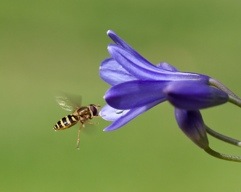
Finally, it helps to learn a bit about the habits of your models. After a while of crouching in the bushes with ants crawling up your trousers you will start to notice that, while honey bees tend to approach flowers in a business-like straight line, bumble bees live up to their name and bumble all over the place. Certain hover flies, particularly the marmalade fly, hover beautifully, while others zoom around oblivious to the fact that they are supposed to be hover flies and are frankly not worth your trouble until they settle.

20120425-102338.jpg

Finally, be prepared to get very funny looks from a lot of people if attempting any of this in public. Good luck!

20120425-102513.jpg

Many thanks to The Goat that Wrote for the idea for today’s post.

PS Before someone asks, I use a 100mm macro lens on a full frame camera. But you could do this just as well with a cropped sensor and another lens.
And, no, I have never been stung.

PPS I have shown some of the images in small size because of problems with downloading really long blog entries.  All of the images stand up to scrutiny at a larger size.  You’re just going  to have to trust me on that 😉

Not-so-solitary bees

20120423-102749.jpg

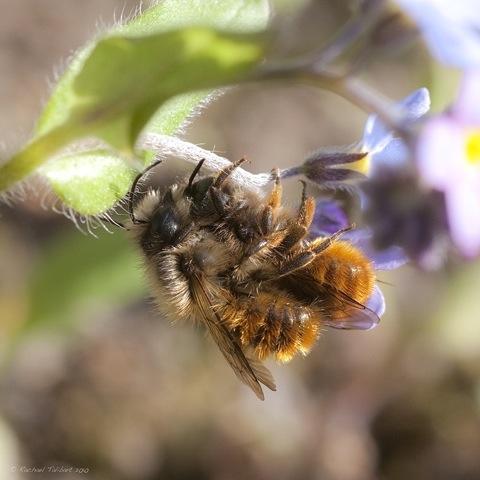
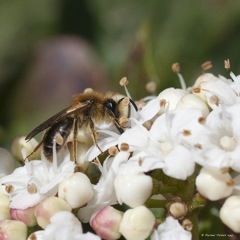
At this time of year there are already many bees busy in the garden but not yet many honey bees. The bumble bees are around, fat, noisy and fairly recognisable. But there are also a lot of solitary bees. In Britain we have more than 250 types of solitary bee, bees that have single nest cells rather than communal hives.
With so many types, I am not going to try to identify the subjects of today’s photographs. To know more, try here. Suffice it to say that solitary bees do have to get together occasionally to obey one particular biological imperative!

20120423-104029.jpg

And, just to prove that they do appear in ones:

20120423-104128.jpg

The shepherds and the wolf

A story in photographs.
(If you don’t like bugs you may want to look away now!)

20120417-122242.jpg

I took this image in my garden last summer. It is part of a story I told with my camera on Flickr over a few days. Here’s the whole thing:

20120417-122426.jpg
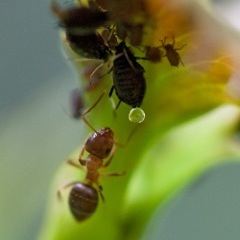
Some species of ant ‘milk’ aphids by stroking them with their antennae. This encourages the aphids to secrete a sticky substance known as honeydew which the ants eat. Here an ant is caught in the act of doing just that. The ants tend their aphid herds like shepherds, protecting them from predators.

20120417-123255.jpg
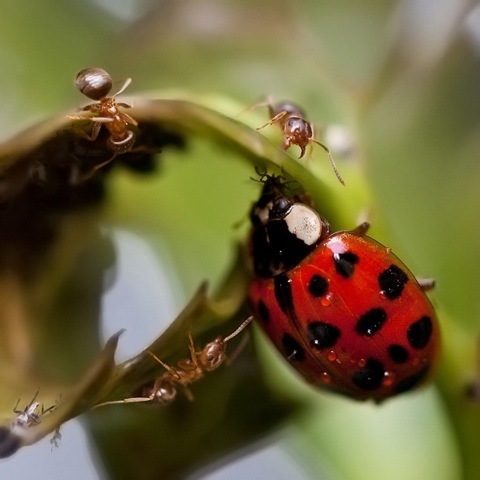
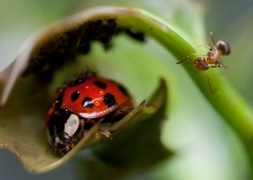
The next day a visitor has appeared. A hungry ladybird (ladybug to my American friends) can think of nothing better than this ready-prepared banquet of its favourite food, aphids. An angry ant-shepherd glares at this wolf in the fold.

20120417-123511.jpg
A day later and the voracious ladybird is still laying siege to aphid city. The ant shepherd has brought in reinforcements but to no avail. The ladybird is like a Sherman tank and angry looks just aren’t going to work. If you look closely you can see an aphid’s legs sticking out of the ladybird’s mouth.

20120417-123709.jpg
Another day later and the shepherds appear to have given up and left their flock to their fate. However, that is not the end of the story. The next day, there was no sign of the ladybird and the ants were back tending their flock as if nothing had ever happened.

Of course, really one should not anthropomorphise animals, but sometimes it is just too tempting.

The art of kindly vacancies

20120416-105232.jpg

This photograph, taken in my garden, demonstrates a style of composition that I often adopt. Particularly when shooting insects, I strive to create simple images, with a bold use of negative space, to show that the subject is small but its world is big. As a viewer of images, I enjoy compositions that are pared down to the minimal, devoid of distracting elements. They are such a direct communication between the photographer and the viewer. At the same tme, they give space for the imagination to become involved.
Once again I find myself calling on John Ruskin as authority:
“It is a great advantage to the picture that it need not present too much at once, and that what it does present may be so chosen and ordered as not only to be more easily seized, but to give the imagination rest, and, as it were, places to lie down and stretch its limbs in; kindly vacancies, beguiling it back into action, with pleasant and cautious sequence of incident; all jarring thoughts being excluded, all vain redundance denied, and all just and sweet transition permitted.” (Modern Painters, Vol III, Part IV, Ch. X)

I have put together a small gallery of images by other photographers, in many different genres, that all display this approach to composition, masters of the art of kindly vacancies. Click here if you’d like to see.

The secret world of small things

20120411-095036.jpg

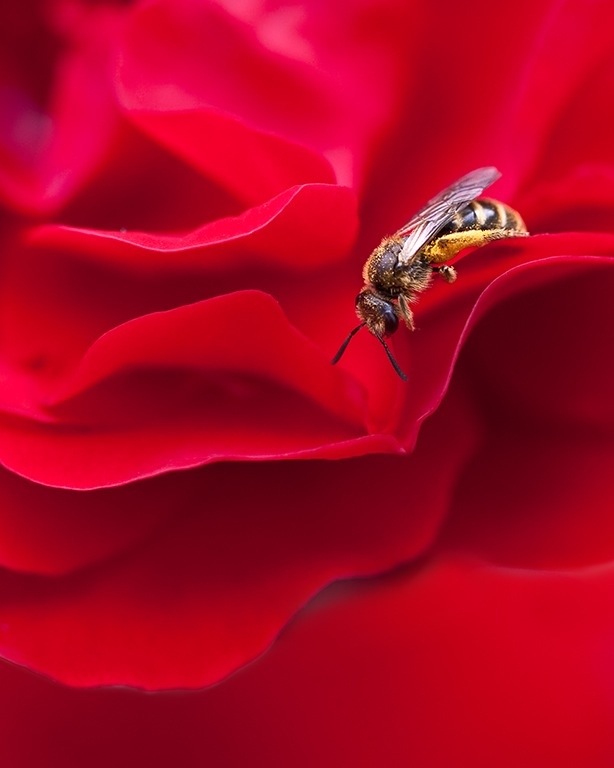
Rose explorer (a tiny bee explores a rose in my garden)

Macro is one of my favourite modes of photography, particularly when the subject is mini-beasts. Perhaps with this subject more than any other, photography has revealed to me a secret world. I try to find points of view that create the impression of seeing the macro landscape as an insect might. My subjects are photographed in natural light, as I find them. I will never move them or otherwise deliberately interfere in their behaviour. I certainly will not immobilise them by putting them in the fridge as many photographers do! If they fly/crawl away before I get my shot, then so be it; it’s part of the challenge. I prefer to show insects interacting with their environment rather than zooming in really close for a ‘scientific’ style of shot.
My family find it strange that I photograph bugs as I used to be afraid of them. Could another benefit of photography be phobia busting? (But I am still afraid of spiders – don’t tell!)